
Email marketing remains one of the most effective ways for healthcare providers to connect with patients. But in an industry governed by strict privacy regulations, creating engaging campaigns while maintaining HIPAA compliance requires careful planning and execution.
This comprehensive guide will show you how to:
- How to craft subject lines that patients can’t resist opening (while staying HIPAA-compliant)
- How to balance HIPAA compliance with creative marketing that actually works
- How to implement a multi-channel approach that amplifies your healthcare messaging across all platforms
Ready? Let’s go!
TL;DR
- Welcome sequences: Send the first email immediately post-signup with practice intro and appointment booking CTA
- Educational newsletters: Feature 3 seasonal health topics with one promoted service and clear booking button
- Appointment reminders: Send 24 hours pre-visit with prep instructions and cancellation policy
- Health awareness campaigns: Include educational content about health topics with risk factors and screening recommendations
- Service promotion emails: Showcase specific patient benefits (“15-minute screenings”) and create urgency with limited appointment slots
- Patient reactivation campaigns: Feature practice updates and offer exclusive priority scheduling


6 Healthcare Email Marketing Sequences You Can't Ignore
Let’s explore the most effective types of emails for healthcare providers.
1. Welcome Email Sequence

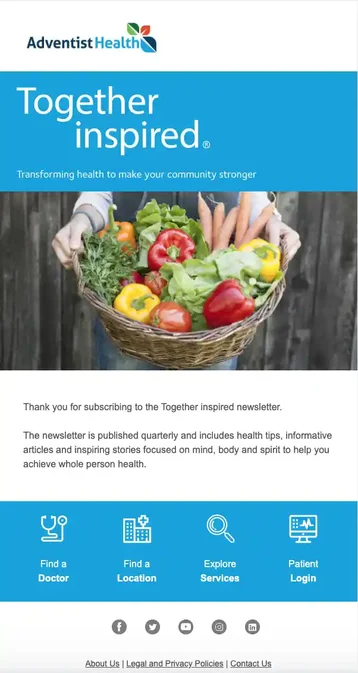
Source: Adventist Health (https://www.adventisthealth.org/)
The welcome email is your opportunity to make a positive first impression with new subscribers or patients. The sequence introduces your healthcare practice, explains your services, and guides patients through important first steps.
| Timing | Subject Line Example | Primary Content | |
|---|---|---|---|
| Welcome | Immediately after sign-up | “Welcome to [Practice Name] – Your Partner in Health!” | Practice introduction, what to expect |
| Practice Overview | Day 3 | “Meet Your Healthcare Team at [Practice Name]” | Staff introductions, services offered |
| Patient Portal Setup | Day 7 | “Set Up Your Patient Portal in 3 Easy Steps” | Portal benefits, setup instructions |
| Health Resources | Day 14 | “Exclusive Health Resources for [Practice Name] Patients” | Educational content, FAQs |
| Appointment Invitation | Day 21 | “Ready to Schedule Your First Visit?” | Booking options, what to expect |
2. Educational Newsletters

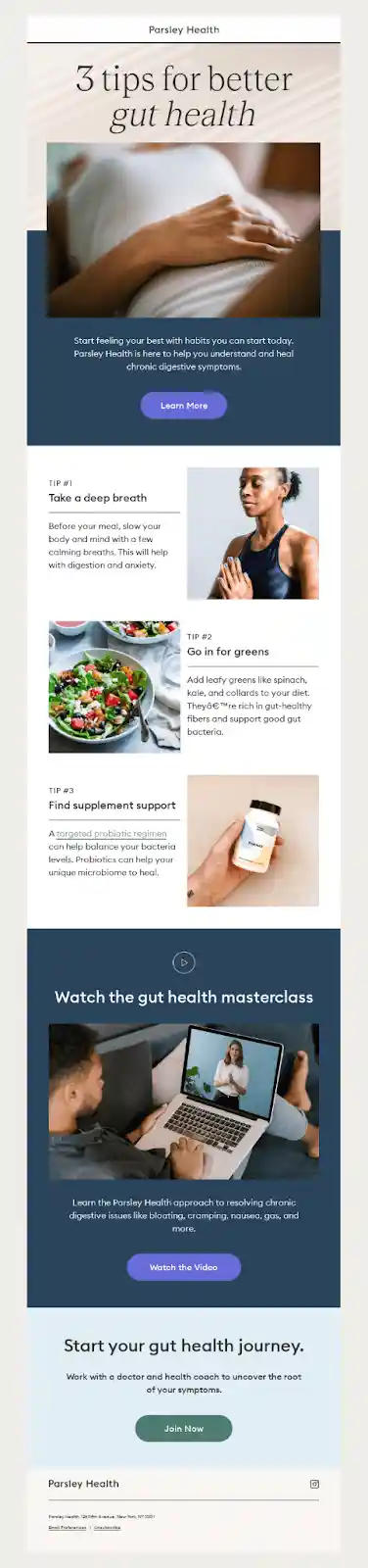
Source: Parsley Health (https://www.parsleyhealth.com/)
Establish your practice as a trusted health authority through regular, informative newsletters that educate patients about relevant health topics. These emails help patients make better health decisions while keeping your practice top-of-mind between visits.
| Timing | Subject Line Example | Primary Content | |
|---|---|---|---|
| Monthly Newsletter | First week of month | “Your Health Update: 3 Tips for Better Sleep” | Featured health topic, seasonal advice |
| Condition-Specific | Based on patient interests | “Living Well with Diabetes: Latest Research” | Condition management, new treatments |
| Wellness Series | Every 2 weeks | “Simple Nutrition Changes for Better Health” | Preventive health, lifestyle tips |
| Medical Myth-Busters | Monthly | “Fact or Fiction: Do Vaccines Cause Flu?” | Evidence-based corrections to common myths |
| Research Roundup | Quarterly | “New Developments in Heart Health Research” | Latest medical advances, study findings |
3. Appointment Reminders and Follow-ups


Source: Pearle Vision (https://www.pearlevision.com/)
Reduce no-shows and enhance patient satisfaction with timely appointment communications that keep patients informed and prepared.
| Timing | Subject Line Example | Primary Content | |
|---|---|---|---|
| Initial Confirmation | Immediately after booking | “Your Appointment is Confirmed” | Date, time, provider details |
| Pre-Visit Reminder | 1 week before appointment | “Preparing for Your Upcoming Visit” | What to bring, preparation instructions |
| Day-Before Reminder | 24 hours before appointment | “Your Appointment Tomorrow at [Practice]” | Final logistics, check-in procedures |
| No-Show Follow-up | Day after missed appointment | “We Missed You – Let’s Reschedule” | Easy rescheduling options |
| Visit Satisfaction | 2 days after appointment | “How Was Your Recent Visit?” | Brief satisfaction survey |
4. Health Awareness Campaigns


Align your email marketing with health observance months and seasonal concerns to provide timely, relevant information that resonates with patients. These campaigns demonstrate your practice’s commitment to preventive care while highlighting your expertise.
Elements to include:
- Educational content about the health topic
- Risk factors and prevention strategies
- Screening recommendations
- Services your practice offers related to the topic
- Patient testimonials (with proper consent)
- Call to action for appointments or screenings
5. Service Promotion Emails

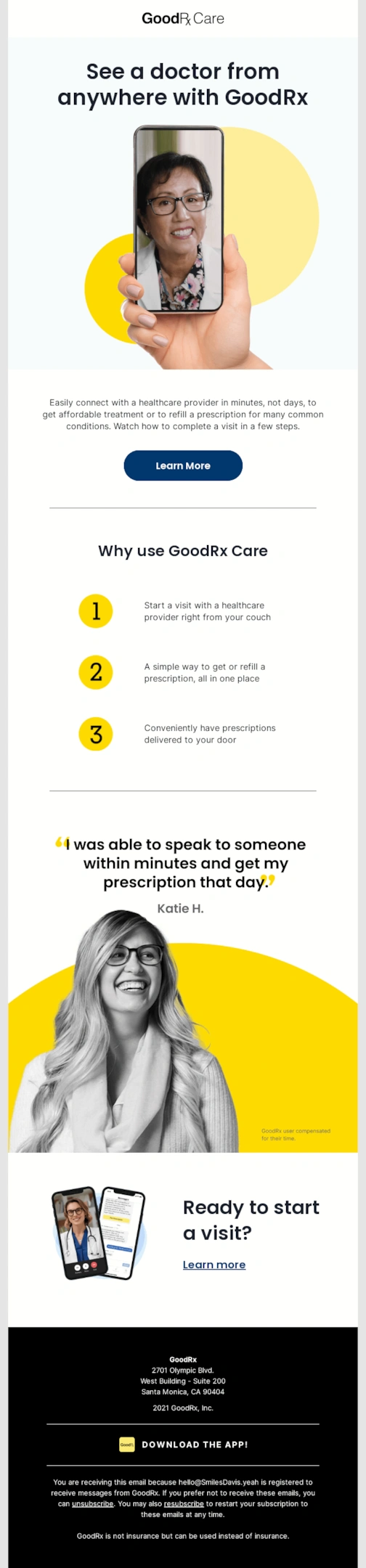
Source: ReallyGoodEmails (https://files.reallygoodemails.com/emails/see-how-easy-it-is-to-talk-to-an-online-doctor.png)
Strategically highlight specific services to relevant patient segments with thoughtful promotional emails that focus on patient benefits.
Best practices:
- Focus on patient benefits rather than technical details
- Include social proof (statistics or testimonials)
- Offer clear next steps
- Use compelling visuals
- Create a sense of urgency when appropriate
| Timing | Subject Line Example | |
|---|---|---|
| Service Introduction | When new service launches | “Introducing Our New Telehealth Services” |
| Early Adopter Offer | 3 days after introduction | “Be Among the First: 15% Off New Service” |
| Patient Testimonial | 7 days after introduction | “How [Service] Changed Sarah’s Life” |
| FAQ Overview | 14 days after introduction | “Your Questions About [Service] Answered” |
| Last Chance | 21 days after introduction | “Last Week for [Service] Special Pricing” |
6. Patient Reactivation Campaigns
Reconnect with patients who haven’t visited in a while through a carefully crafted re-engagement series that reminds them of the importance of regular care. These nurturing emails help recover potentially lapsed patients while reinforcing the value your practice provides.
| Timing | Subject Line Example | |
|---|---|---|
| Friendly Check-in | 6 months after last visit | “We’ve Missed You at [Practice Name]” |
| Health Reminder | 2 weeks after check-in | “Is It Time for Your Annual Check-up?” |
| New Offerings | 4 weeks after check-in | “What’s New at [Practice Name]” |
| Special Incentive | 6 weeks after check-in | “Come Back and Save: Returning Patient Offer” |
| Final Outreach | 8 weeks after check-in | “One Last Note from Dr. [Name]” |
P.S. Our segmentation tools allow you to identify inactive patients and deliver personalized messages. Best part? You can automate the re-engagement campaign with the journey builder – set it up once and let it run!


Read Next:
Best Practices for HIPAA-Compliant Email Marketing
Note: This guide provides general marketing information only and should not be interpreted as legal or compliance advice. Do not use the platform to store or transmit protected health information (PHI).
Now let’s explore how to optimize your healthcare email marketing while maintaining strict HIPAA compliance.
Understanding HIPAA Compliance
Before diving into strategy, let’s establish what HIPAA compliance means for your email marketing efforts.
What is Protected Health Information (PHI)?
Protected health information includes any individually identifiable health information that relates to:
- A patient’s past, present, or future physical or mental health condition
- Healthcare services provided to the patient
- Payment information for healthcare services
This can include names, addresses, dates (birth, admission, discharge), phone numbers, email addresses, medical record numbers, health plan beneficiary numbers, and more.
Considerations for Healthcare Marketers
When sending marketing emails to patients or prospective patients, healthcare providers must:
- Obtain explicit written consent before sending any marketing emails containing PHI
- Use a HIPAA-compliant email platform that encrypts data in transit and at rest
- Limit PHI in emails to the minimum necessary information
- Provide clear opt-out options in every email
- Maintain accurate email lists and promptly remove unsubscribes
What Can and Cannot Be Included in Healthcare Emails
| Permitted in Healthcare Emails | Not Permitted Without Proper Security & Consent |
|---|---|
| General health tips and education | Patient names linked to conditions |
| Service announcements | Treatment details for specific patients |
| Appointment reminders (without condition details) | Test results or diagnoses |
| Wellness newsletters | Medication information |
| Practice updates | Billing information with identifiers |
| Community health event invitations | Insurance details |
Crafting Compliant and Engaging Subject Lines
Your subject line is crucial for both compliance and open rates:
Do:
- Be clear and specific about the email’s content
- Use action-oriented language
- Include personalization when appropriate
- Create a sense of value or urgency
Don’t:
- Include any PHI or patient-specific health information
- Use misleading or deceptive language
- Make unrealistic health claims
Effective healthcare subject line examples:
- “Your Appointment Reminder for Thursday”
- “5 Simple Ways to Manage Seasonal Allergies”
- “New Extended Hours at [Practice Name]”
- “Important: Updates to Our Patient Portal”
- “Join Us: Community Health Fair This Saturday”
Campaign Monitor automatically appends opt-out language to comply with regulations.
Read Next:
9 Best Healthcare Email Marketing Strategies You Shouldn't Skip
Creating an effective email marketing strategy for your healthcare practice is about fostering meaningful connections, delivering valuable content, and building trust with every message.
#1) Setting Clear Goals for Your Campaigns
Successful healthcare email marketing begins with defining specific objectives:
- Building awareness for your healthcare practice
- Educating patients about health conditions and preventive care
- Promoting specific services or specialties
- Improving patient engagement and retention
- Driving appointment bookings
- Gathering patient feedback and testimonials
#2) Understanding Your Target Audience
Different patient segments have different needs and interests. Consider segmenting your audience by:
- Demographics (age, gender, location)
- Patient status (new, current, former)
- Health interests or conditions (without using PHI)
- Engagement level with previous communications
- Service utilization history (general categories only)
#3) Creating a Content Calendar
Plan your email content in advance with a strategic calendar that includes:
- Seasonal health topics (flu season, allergy season, etc.)
- Health awareness months relevant to your practice
- Regular newsletters with valuable health information
- Service promotions and special offers
- Follow-up sequences for new patients
- Re-engagement campaigns for inactive patients
#4) Segmentation and Personalization Without Compromising PHI
Strategic segmentation improves engagement without risking compliance:
- Segment by general categories rather than specific conditions
- Use behavioral data (email opens, clicks) for targeting
- Personalize using non-PHI information (first name, general location)
- Create content relevant to broader demographic groups
- Allow patients to self-select interests through preference centers
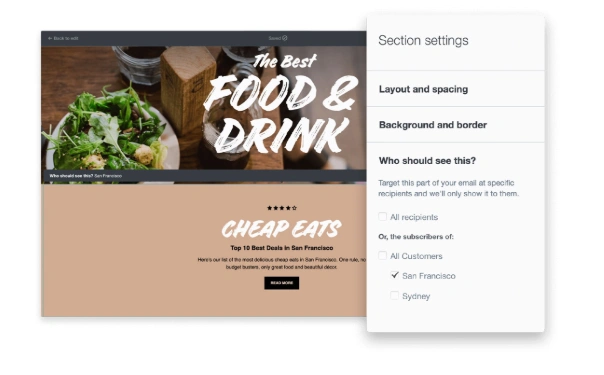
BTW, Our dynamic content blocks revolutionize how healthcare providers can personalize communications. This powerful feature allows you to show different content to different subscribers within the same email based on various data points, eliminating the need to create multiple versions of each campaign.

#5) Optimizing Email Design for Healthcare
Design considerations for healthcare emails:
- Use a clean, professional layout that reflects your practice’s branding
- Ensure mobile responsiveness (over 60% of emails are opened on mobile)
- Include your practice logo and consistent color scheme
- Use high-quality, relevant images (with proper licensing)
- Create a clear hierarchy with headers and subheaders
- Use white space effectively to improve readability
- Place important information and CTAs “above the fold”
- Include alternative text for images for accessibility
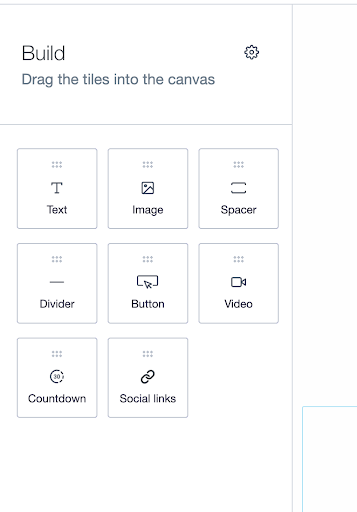
Campaign Monitor’s responsive templates and intuitive drag-and-drop builder ensure your healthcare emails look professional and on-brand across all devices. The platform’s auto-branded templates can generate designs that reflect your practice’s logo, fonts, and colors just by entering your website URL, saving valuable time while maintaining consistent branding.

#6) Testing and Measuring Performance
Regular testing and analysis help improve your email marketing results:
- A/B test subject lines, send times, and CTAs
- Monitor key metrics like open rate, click-through rate, and conversion rate
- Compare performance against healthcare industry benchmarks
- Survey subscribers periodically about content preferences
- Use heat mapping to see which content gets the most attention
- Track appointment bookings or form completions from email campaigns
Our A/B testing engine allows healthcare providers to scientifically optimize every element of their emails, from subject lines to call-to-action buttons.


#7) Implementing Automated Email Sequences
Automation saves time while delivering timely, relevant content:
New patient onboarding sequence:
- Welcome email (immediately after sign-up)
- Practice introduction and services (day 3)
- Patient portal setup guide (day 7)
- Health resources and educational content (day 14)
- Invitation to schedule first appointment (day 21)
Post-appointment sequence:
- Thank you and visit summary (same day)
- Follow-up care instructions (1-2 days after)
- Feedback request (3-5 days after)
- Educational content related to visit (1 week after)
- Preventive care reminder (1 month after)
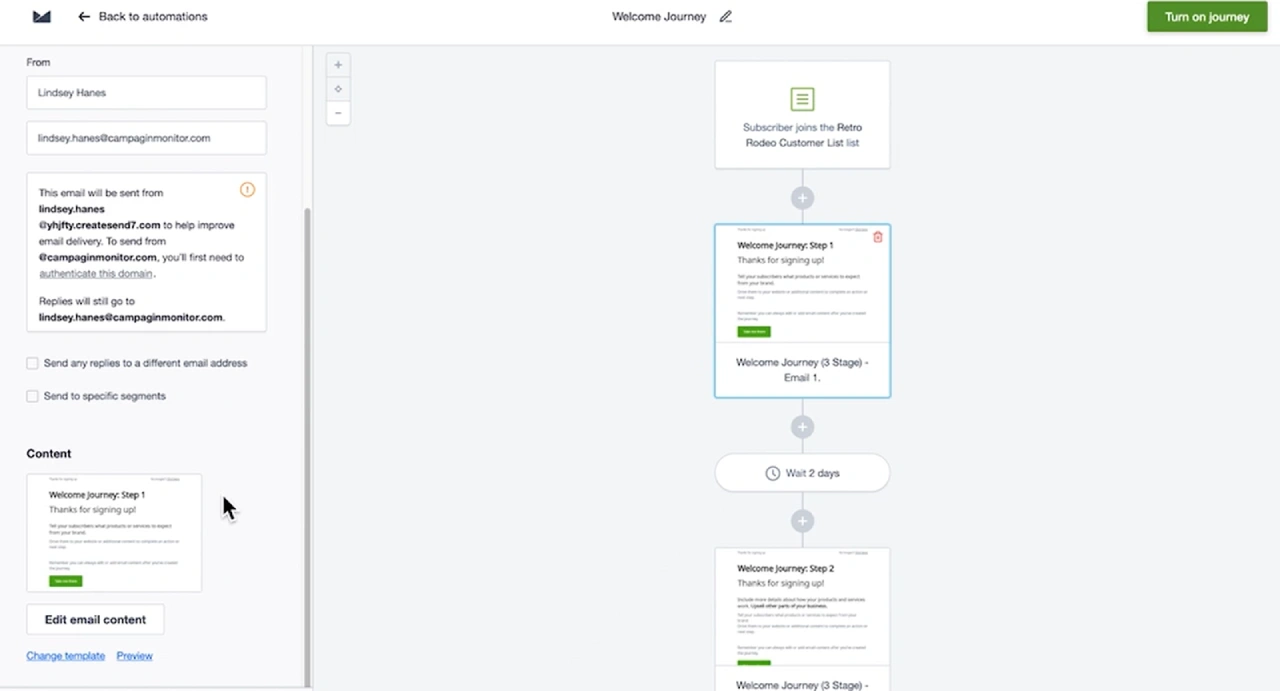
Campaign Monitor’s journey builder allows you to create behavior-triggered workflows that deliver the right message at the right time.

#8) Integrating Email with Other Marketing Channels
Create a cohesive patient experience across all touchpoints:
- Coordinate email content with social media campaigns
- Use consistent messaging across your website, emails, and printed materials
- Promote your email newsletter on social media
- Include social sharing buttons in emails
- Retarget email subscribers with relevant digital ads
- Drive traffic from emails to specific landing pages on your website
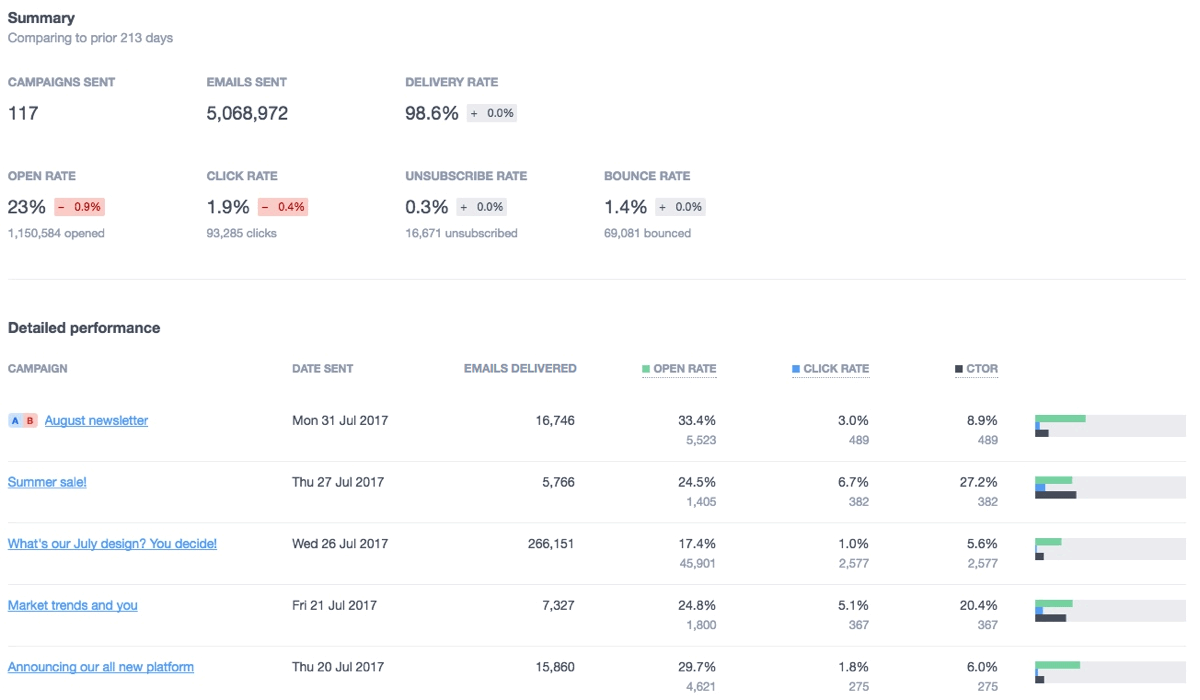
Our comprehensive analytics dashboard enables healthcare providers to track progress toward specific campaign goals with precision. The platform’s real-time performance tracking allows practices to measure open rates, click-through rates, and conversions

#9) Leveraging Patient Testimonials and Success Stories
Social proof builds trust and credibility:
- Always obtain written permission before using patient testimonials
- Focus on the patient experience rather than specific medical outcomes
- Remove any PHI or identifying details
- Include before/after photos only with explicit consent
- Consider video testimonials for greater impact
- Feature diverse patients representing your target audience
Read Next:
Building a Sustainable Healthcare Email Strategy Made Easy with Campaign Monitor
Effective healthcare email marketing requires balancing engagement with compliance, but the results are worth the effort.
Key Takeaways:
- HIPAA compliance is non-negotiable for healthcare email marketing
- Segmentation and personalization drive engagement without compromising privacy
- Educational content builds trust and positions your practice as an authority
- Regular testing and optimization improve performance over time
- A strategic approach to email marketing can significantly impact patient acquisition and retention
Campaign Monitor offers a powerful combination of automation, advanced segmentation, comprehensive analytics, and professional design tools, making it an ideal solution for healthcare providers looking to enhance patient communication without adding administrative burden.
With Campaign Monitor, you have all the tools needed to execute the most effective healthcare email marketing campaigns.
Read Next: