We’re passionate about getting your emails to their intended inboxes
That’s why we work hard to maintain our competitive 99% delivery rate.*
Try it free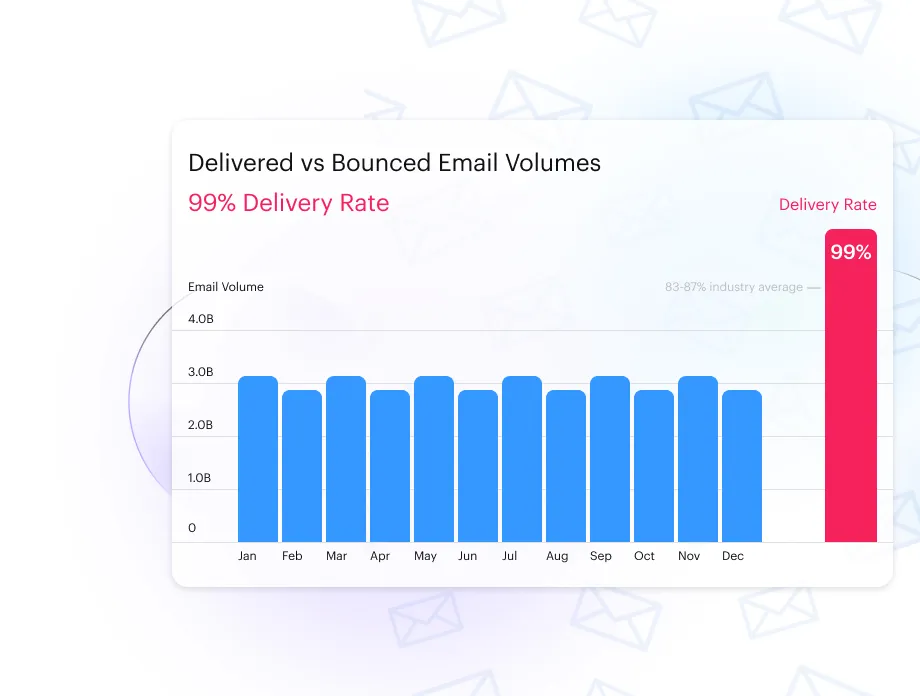
That’s why we work hard to maintain our competitive 99% delivery rate.*
Try it free Expert email support helps businesses use their platform with more confidence while improving campaign quality and results.
With the right partner, businesses can build more effective email programs without adding unnecessary complexity.
Why should I care about deliverability?
Even your best emails won’t land in the inbox without great deliverability—don’t get stuck in their spam. Choose Campaign Monitor by Marigold where our average 99% delivery rate* is among the best in the industry.
Our team is doing their part to optimize for consistent inbox placement, not just high delivery rates. They’re so passionate about what they do, they even produce content on the subject, providing in-depth 1:1 support you need to be successful.
Deliverability requires a dedicated approach from your email service provider, plus your active participation, to get your emails where they need to go. To support you in doing your part, we share deliverability best practices across our website and platform, giving you clear guidance and support every step of the way.
Our 99% delivery rate is the result of decades of expertise and hard work. By following best practices and partnering with us, you can strengthen your sender reputation and increase inbox placement over time. We’ve helped countless customers improve their deliverability, and we’re committed to helping you do the same.
How to improve your delivery rate
While we work hard to do our part to ensure you have a great chance at getting delivered to your audience’s inboxes, here’s more information on best practices you can adopt to be successful.
Authenticate your sending domain
Implementing SPF, DKIM, and DMARC authentication helps meet mailbox providers’ bulk sender requirements. This authentication ensures you’re seen as a legitimate sender and reduces the likelihood of bad actors using your domain to send spam. We have in-app notifications that help you correctly set up authentication, and an Email Authentication Troubleshooting help doc to resolve these common errors.
Undertake subscriber list hygiene
Regularly maintain your subscriber lists by removing inactive and invalid email addresses. Campaign Monitor’s powerful segment builder can help you identify unengaged and dormant contacts. You can then send a re-engagement campaign to revive the unengaged and remove the dormant contacts. We also have prebuilt dynamic engagement segments on some of our plans.
Send regular emails
Sending emails regularly helps establish your reputation with mailbox providers. That’s not to say you need to be sending daily emails. Instead, strike a balance between keeping your audience updated with offers, product releases, and other news every week or two. It’s crucial that you view your campaign reports to monitor your results after each send and establish trend lines to measure success.
Need expert help improving inbox placement?
Learn more about our deliverability consulting services.
We have a dedicated team focused specifically on deliverability optimisation. Our team works to optimise for consistent inbox placement, not just high delivery rates. They’re passionate about what they do and spend considerable time monitoring our overall deliverability and sender reputation, producing educational material and engaging in industry discussion, and providing in-depth 1:1 support to help you succeed. Our 99% delivery rate* is the result of decades of expertise and hard work.
Unlike the delivery rate, which measures if your email was accepted or rejected by the mail server, deliverability is about whether your email reaches and engages real inboxes. That’s where your role as a sender matters most. Deliverability requires a partnership. We do our part by maintaining infrastructure and reputation, and we make it simple for you to do yours. Your active participation is essential for getting emails where they need to go. To support you, we share deliverability best practices across our website and platform, giving you clear guidance and support every step of the way.
Yes, email authentication (SPF, DKIM, and DMARC) is essential, but it’s just the foundation. Authentication tells mailbox providers like Gmail, Yahoo and Microsoft, who you are, but inbox placement is driven by sender behaviour, list quality, and long-term engagement patterns. Think of authentication as your credentials, not your guarantee of trust.
No, unsubscribes are healthy for your program. They help maintain list hygiene and reduce spam complaints. It’s better to lose a disinterested subscriber than keep one who drags down your metrics or reports your emails as spam. A clean, engaged list performs better than a large, unengaged one. However, if you consistently see a high number of unsubscribe rates, it’s worth looking at the ways you collect addresses and make sure they are directly opting in for your content.
Not necessarily. Sending more emails indiscriminately can hurt your deliverability. Quality beats quantity every time. Inbox providers prioritise engagement, so sending to people who aren’t opening, clicking or otherwise engaging will drag your sender reputation down. A curated, engaged list with personalised content will deliver better results than one only serving vanity metrics.
Modern spam filters are more sophisticated than simple word-based filtering. Words like “free” or “buy now” won’t automatically land you in spam unless paired with other red flags like poor sender reputation or low engagement. Focus on subscriber engagement and relevant content rather than avoiding specific words.
No, it won’t, and it’s a tactic that spammers use to try and get around spam filtering. Think of your Sender Reputation like your credit score; if you have a bad score, it doesn’t matter which financial institution you use. Mailbox providers use 100s, if not 1000s, of signals to fingerprint incoming emails, so switching IPs without fixing root causes like poor list management or aggressive sending practices will only transfer the problem. Any changes to your sending infrastructure should be carefully managed, and it’s essential to address the fundamentals first.
No, you must follow the privacy and email laws of your subscribers’ countries, not just your own. This means understanding and complying with regulations like GDPR, CAN-SPAM, CASL, and others, depending on where your subscribers are located. You also need to follow our Terms of Use and Anti-Spam policies, which are based on these laws and the requirements set by mailbox providers for bulk senders. Together, these ensure successful email delivery and high deliverability.
While mailbox providers (MBPs) do have filters and algorithms, poor deliverability typically stems from sender behaviour rather than MBPs being “unfair.” It is also unlikely to be the ESP’s fault, since so much of deliverability, successfully landing in the inbox, is specific to each bulk sender. Most deliverability issues are fixable with better list management, audience segmentation, and engagement-based sending practices. We’ve helped countless customers improve their deliverability by focusing on these fundamentals.
Not automatically. If you’re experiencing inbox issues, the problem often goes beyond your ESP. Issues like spam complaints, high bounce rates, or poor engagement patterns will follow you to a new platform. A new ESP can help diagnose problems and guide improvements, but you’ll still need to address underlying list quality and sending practices. By following best practices and partnering with us, you can strengthen your sender reputation and increase inbox placement over time.
* Based on internal data approved on February 5, 2026
Here are answers to our most common questions about email deliverability:
Email deliverability measures how many of your emails reach your readers’ inboxes, rather than being blocked or routed to spam folders. Deliverability tells you whether it arrived where subscribers can engage with it.
Inbox providers like Gmail, Yahoo and Microsoft evaluate hundreds of signals when deciding placement, from authentication setup to engagement patterns. Campaign Monitor maintains a 99% delivery rate but delivery is just acceptance by the receiving server. What matters is inbox placement: whether your message lands where subscribers actually see it. That’s what we focus on.
Delivery rate measures whether the receiving server accepted your email. Deliverability measures whether that email reached the inbox and engaged real people. You can have excellent delivery but poor deliverability if messages land in spam folders.
Campaign Monitor tracks precise delivery and shows bounce and acceptance metrics. However, deliverability requires a broader view. We help you monitor open rates, click-through rates, spam complaints, and unsubscribe patterns. These engagement signals directly impact your sender reputation, which inbox providers use to decide placement.
Marketing email frequency depends on your value, audience, and industry. Most successful marketers find a rhythm between weekly and biweekly sends—this balances engagement without overwhelming subscribers. The key is consistency paired with relevance.
Use Campaign Monitor’s segmentation tools to tailor frequency based on subscriber behavior. You can also monitor your campaign reports after each send to identify engagement patterns. Quality beats quantity—subscribers stay engaged when every message offers value.
Poor deliverability stems from technical setup, list quality, and engagement patterns. Misconfigured authentication (SPF, DKIM, DMARC) tells inbox providers you’re not verified, triggering spam filters. Weak list hygiene, like purchased lists, outdated addresses, or subscribers who never opted in, can damage reputation.
Low engagement is equally harmful. When recipients consistently ignore emails, inbox providers start filtering messages away from the inbox. Campaign Monitor addresses these challenges with built-in list management, authentication, and engagement guidance.
Spam filters have evolved beyond simple keyword detection. Words like “free” used to trigger filters automatically. Now, systems evaluate factors like sender reputation, authentication setup, engagement history, link quality, and recipient behavior. A message with “free” won’t land in spam if it comes from a trusted sender with strong engagement.
Context matters more than individual words. Inbox providers track whether recipients open, click, delete, or mark messages as spam. Rather than fixating on word choice, focus on building engagement and maintaining best practices. You’ll want to send relevant content to engaged subscribers from an authenticated domain.
Campaign Monitor combines robust infrastructure and hands-on expertise to maximize inbox placement. Our dedicated deliverability team monitors industry shifts, sender reputation, and evolving requirements.
Built-in authentication support helps you implement SPF, DKIM, and DMARC correctly. Our segmentation and personalization features let you target engaged audiences. When challenges arise, our team provides one-on-one support to catch issues and implement fixes.
Campaign Monitor reports let you spot deliverability trends before they become problems. Monitor bounce rates and acceptance rates to confirm emails are clearing mail servers. You’ll also want to dig into engagement signals. For example, open rates show whether messages reach the inbox, while click-through rates gauge relevance.
Watch for unsubscribe and spam complaint rates, as spikes hurt sender reputation. Our detailed reporting dashboard breaks these metrics down by campaign. This way, you can compare performance over time and identify patterns. Review reports consistently and act on insights to maintain strong deliverability.
Our powerful, easy-to-use marketing tools can help your business take off.
Sign up for free