21 minute read time
Best CRMs for Agencies in 2026

“Pick a CRM and the rest will follow” sounds good—until onboarding slows down, pipelines get messy, and client emails end up scattered across different tools. The real cost isn’t the CRM itself—it’s the context switching, inconsistent data, and slow handoffs that quietly drain your team’s time and attention.
In this guide, you’ll find:
- The 11 best agency CRMs, side‑by‑side
- How to pick (by size, stack, complexity)
- Why pairing a CRM with best‑in‑class comms (Campaign Monitor) wins
If you care about predictable email delivery, brand-consistent templates, and automation tools that scale with your client roster, Campaign Monitor offers features such as drag-and-drop email design, advanced segmentation, and automated journeys that support agencies managing many accounts at once.
Read on to see how the right CRM—paired with the right communication stack—can transform your operations.
What agencies actually use CRMs for
“CRM” can sound abstract until you map it to daily agency work. In practice, agencies rely on CRMs to:
Standardize client onboarding: Capture deals from forms, qualify opportunities, and move new clients through a consistent onboarding pipeline—access requests, kickoffs, asset collection, and initial campaigns.
Coordinate sales → delivery handoffs: Keep scopes, expectations, and timelines in one place so sales, accounts, and delivery teams don’t rely on scattered docs or DMs.
Track pipeline, revenue, and capacity: See which services are growing, which clients are at risk, and where your team is overloaded or underutilized.
Support QBRs and ongoing reporting: Pull pipeline, performance, and activity data into dashboards you can reuse and refine for QBRs and renewals instead of rebuilding reports every quarter.
Manage renewals and expansions: Track contract end dates, upsell opportunities, and renewal risks with reminders and automation instead of hoping someone “remembers.”
When you evaluate CRMs, stress-test them against these workflows—not just generic “contact management.”
TLDR: Best CRMs for agencies at a glance
| CRM | Best For | Key Features | Pricing |
|---|---|---|---|
| HubSpot Sales Hub | Scaling multi-service agencies | Pipelines, sequences, Playbooks, reports, forecasting, automations, native email | 14-day free trial; $890/mo – Professional, $3600/mo – Enterprise |
| Pipedrive | Sales-centric teams | Visual pipelines, automations, activity tracking, basic forecasts, integrations | 14-day free trial; $19/mo – Lite, $34/mo – Growth, $64/mo – Premium, $89/mo – Ultimate |
| Zoho CRM | Value + customization | Custom modules, CommandCenter, workflows, AI (Zia), multi-channel automation | 15-day free trial; $20/user/mo – Standard, $35 – Professional, $50 – Enterprise, $65 – Ultimate |
| monday sales CRM | Work + CRM in one | Boards, automations, dashboards, integrations, pipeline + delivery handoff | 14-day free trial; $15/mo – Basic, $20 – Standard, $33 – Pro, Enterprise (contact sales) |
| Salesforce Sales Cloud | Complex, enterprise ops | Custom objects, Flow automation, forecasting, Einstein AI, governance | 30-day free trial; $25/user/mo – Starter, $100 – Pro |
| Insightly | CRM + basic PM | Pipelines, automations (higher tiers), built-in projects, reporting, AppConnect | 14-day free trial; $29/mo – Plus, $49 – Professional, $99 – Enterprise |
| Podio | Build-your-own CRM | Custom apps, multiple views, automations, granular permissions | Free (up to 5 employees); $14/mo – Plus, $24/mo – Premium |
| Apptivo | Modular CRM + ops suite | 18–65 apps, workflows, dashboards, CRM + projects + invoicing | 14-day free trial; $20/mo – Lite, $30 – Premium, $50 – Ultimate, Enterprise (contact sales) |
| Productive.io | Full agency OS + CRM | Sales CRM, budgeting, resourcing, time, projects, profitability reporting | 14-day free trial; for 10 users: $11/mo – Essential, $28 – Professional, $39 – Ultimate |
| EngageBay | Budget all-in-one | CRM, marketing automation, email, chat, helpdesk, workflows | Free; $14.99/mo – Basic, $39.99 – Growth, $79.99 – Pro |
| Stackby | Spreadsheet-database CRM | Custom tables, API connectors, automations, multiple views | 14-day free trial; Free (5 users); $10/mo – Economy, $18 – Business, $30 – Pro, Enterprise (contact sales) |
How we evaluated the best CRMs for agencies
To identify the best CRMs for agencies in 2026, each platform was scored across five criteria that matter most for real agency workflows:
- Pipeline & workflow capabilities
- Reporting depth and forecasting accuracy
- Ease of implementation and onboarding time
- Integrations across email, billing, PM, ads, and support
- Scalability for multi-client environments
For a deeper dive into how CRM marketing actually works—segmenting audiences, using data, and personalizing campaigns—check out our guide: All About CRM Marketing.
11 Best CRMs for agencies
Agencies don’t just need a place to store contacts—they need clear pipelines, cross-team visibility, automation that removes manual work, and reporting clients can trust. The CRMs below stand out for reliability, usability, and scalability across different agency models.
1. HubSpot Sales Hub — Best for scaling multi-service agencies
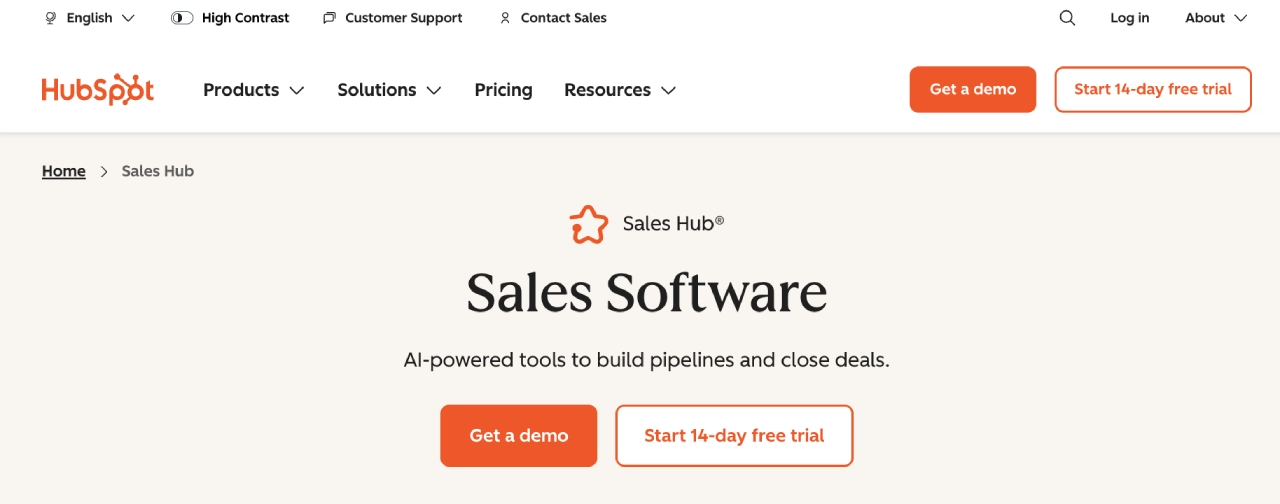
HubSpot is a full-funnel CRM with pipelines, sequences, Playbooks, reporting, ads tools, and native email.
It balances ease of use with enterprise depth. Pipelines and automations are simple to configure, reporting scales with complexity, and its large integration ecosystem makes it ideal for multi-team, multi-client workflows.
Best for: Agencies handling multiple service lines that need strong automation, repeatable processes, and reliable forecasting as they grow.
Key features: Deal pipelines, sequences, Playbooks, custom reports, forecasting, automated tasks, and native email/meeting tools.
Pricing: 14-day free trial; $890/mo – Professional; $3600/mo – Enterprise
Pros: Deep automation + reporting; huge integration ecosystem.
Cons: Pro/Enterprise require onboarding; add-ons and extra seats increase cost.
2. Pipedrive — Best for sales-centric agencies
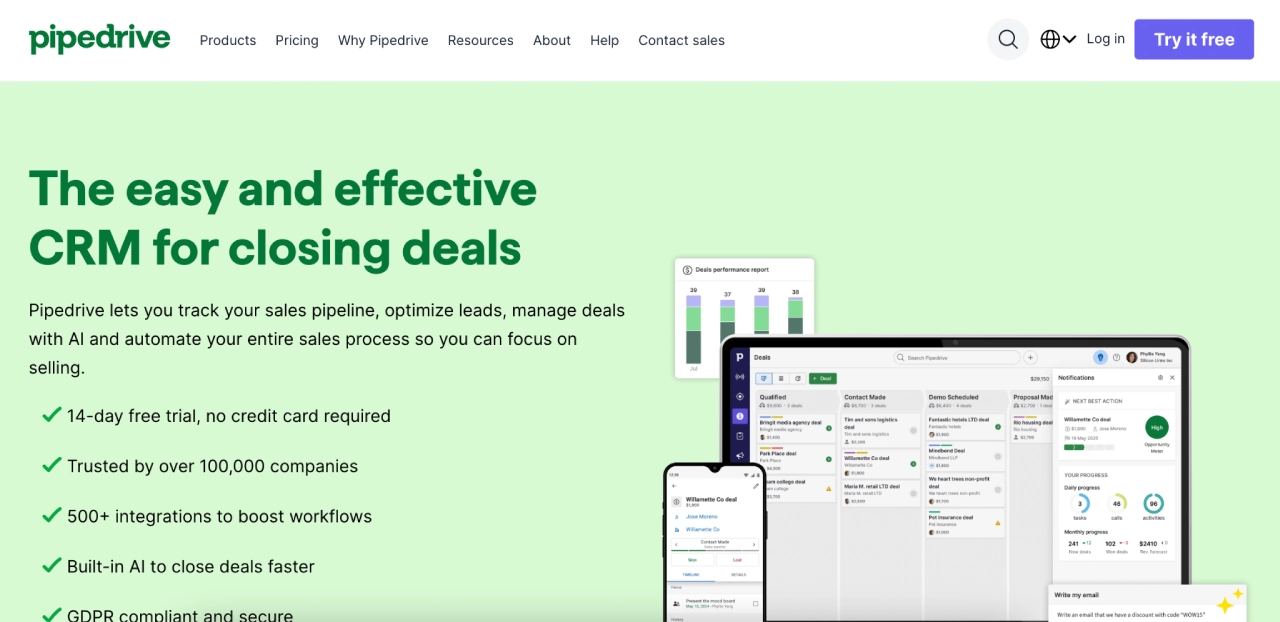
Pipedrive is a sales-focused CRM built around a clear, visual pipeline. It’s designed to help reps track deals, activities, and follow-ups with minimal friction.
Its simplicity and strong deal visibility make it a favorite for teams that prioritize sales execution over complex, multi-department workflows.
Best for: Agencies with SDR/BDR motions or teams that need clean, rep-friendly pipelines without heavy setup.
Key features: Visual pipelines, workflow automation, activity and deal tracking, basic forecasting, insights, and a large integration library.
Pricing: 14-day free trial; Tier-based: $19/mo – Lite; $34/mo – Growth; $64/mo -Premium; $89/mo – Ultimate
Pros: Extremely easy to use; strong deal visibility; fast onboarding; helpful automations for routine tasks.
Cons: Limited native marketing features; many advanced capabilities require higher-tier plans or add-ons.
3. Zoho CRM — Best value + deep customization
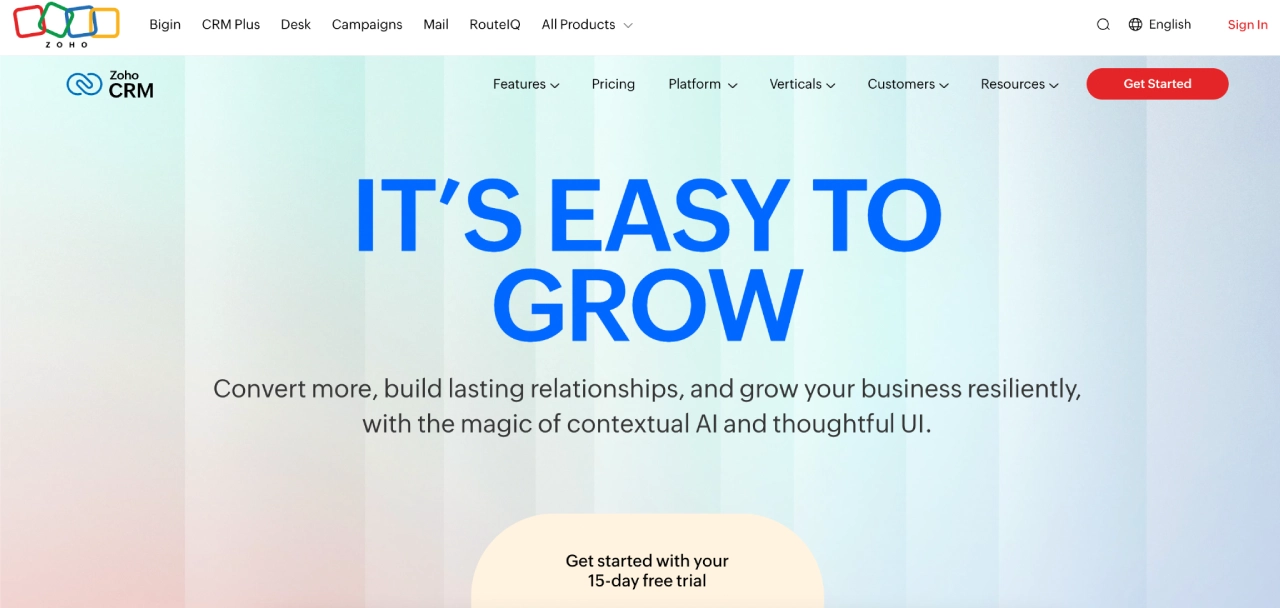
Zoho CRM is a cloud-based customer relationship management platform for managing sales, marketing, and support in one system, with strong automation and AI (Zia) plus extensive customization.
Best for: Agencies that want end-to-end customization and automation without enterprise-level pricing.
Key features: Custom modules, CommandCenter journey orchestration, workflows, AI predictions/insights via Zia, and multi-channel sales automation.
Pricing: 15-day free trial; Tier-based: $20/user/mo – Standard; $35/user/mo – Professional; $50/user/mo – Enterprise; $65/user/mo – Ultimate
Pros: Strong automation and AI for the price; highly flexible and customizable; broad feature set even at mid tiers.
Cons: Interface can feel busy; initial setup and customization may take time for new teams.
Leaning toward Zoho? Go a step further by connecting it directly to Campaign Monitor.
4. monday sales CRM — Best for “work + CRM” teams
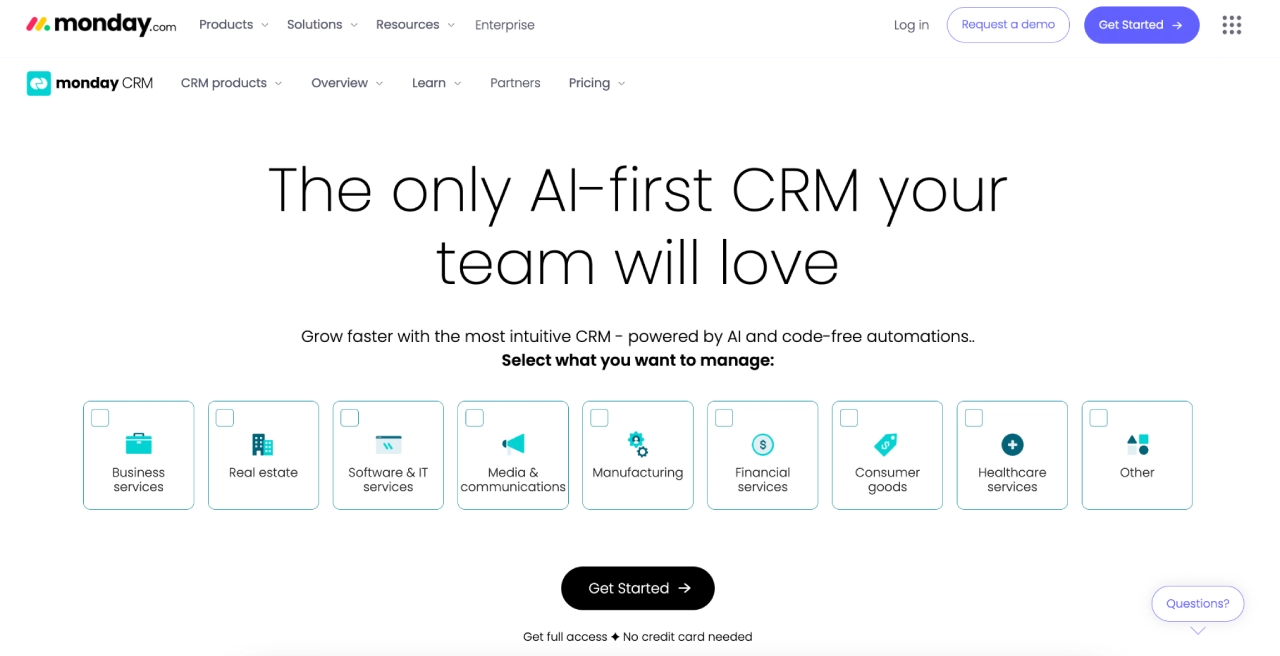
monday sales CRM is a cloud-based CRM built on the monday.com Work OS, combining visual boards, automations, dashboards, and integrations so teams can manage sales pipelines and related work in one place.
Best for: Agencies that need CRM + project / delivery visibility in a shared workspace (e.g., sales, accounts, and ops collaborating on the same boards).
Key features: Boards and multiple views, no-code automations, customizable dashboards, integrations, pipeline and deal tracking, and handoff workflows from sales to delivery.
Pricing: 14-day free trial; tier based pricing per seat: $15/mo- Basic; $20/mo – Standard; $33/mo – Pro; Contact sales for Enterprise plan
Pros: Highly visual and user-friendly; good for cross-functional teams; strong collaboration and workflow automation.
Cons: Automation and integration limits vary by tier, so many teams need higher plans; overall cost rises with seats and add-ons.
5. Salesforce Sales Cloud — Best for complex, enterprise-grade operations
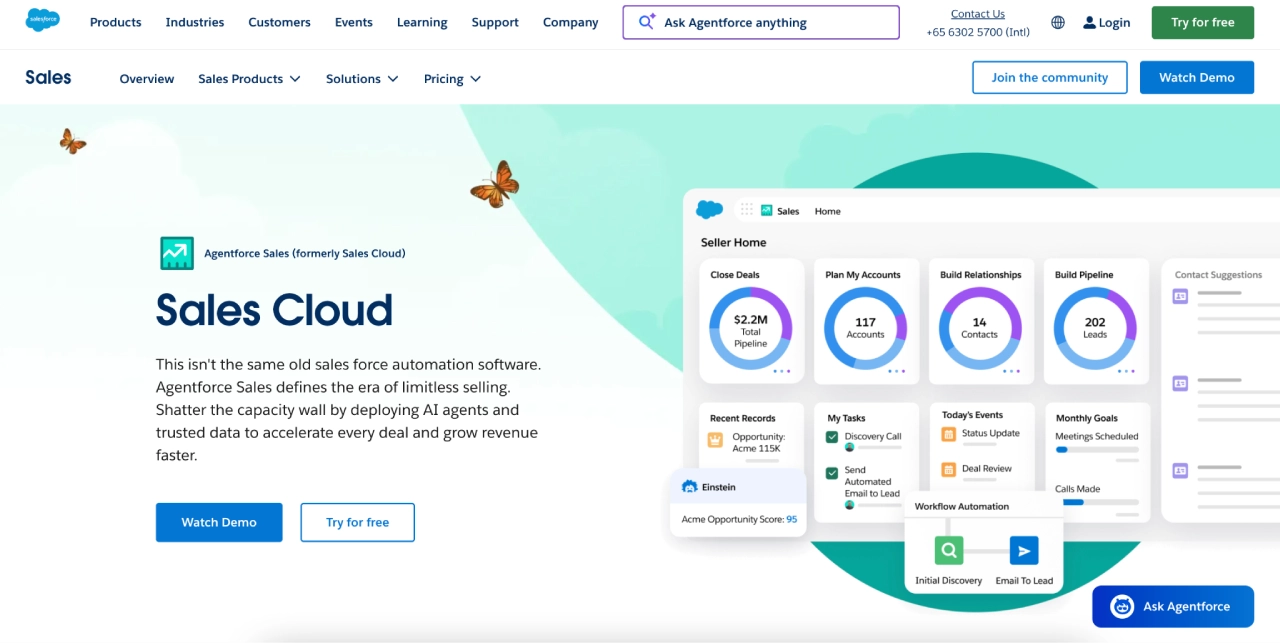
Salesforce Sales Cloud is an enterprise CRM platform with deep customization, automation, and AI on the Salesforce Platform, letting teams build custom objects, workflows, and interfaces for complex sales processes.
Best for: Agencies that need strict governance and highly tailored workflows—custom objects, multi-layer approvals, territory management, and advanced security at scale.
Key features: Custom objects and fields, Flow automation and approvals, advanced reporting and forecasting, Einstein AI, strong security controls, and a large AppExchange ecosystem.
Pricing: CRM trial free for 30 days; Tier-based pricing per user: $25/mo – Starter; $100/mo – Pro
Pros: Extremely high customization potential; robust enterprise tooling and governance; huge partner and app ecosystem.
Cons: Higher total cost of ownership; typically requires dedicated admins/consultants and a heavier implementation effort.
NORD cultivates a community where individuals can live their best rare lives
How the National Organization for Rare Disorders uses email to educate, raise awareness, and connect the rare disease community to life-changing opportunities.
higher open rates than the industry average
open rate on event recap emails
members in the Rare Action Network

We wanted an email solution that integrated with Salesforce—but more importantly, one that made it easy to get critical information to people when they need it most. We accomplish all of that and more.
Create a flow
Add your email list
Start sending
6. Insightly — Best for CRM + basic project management
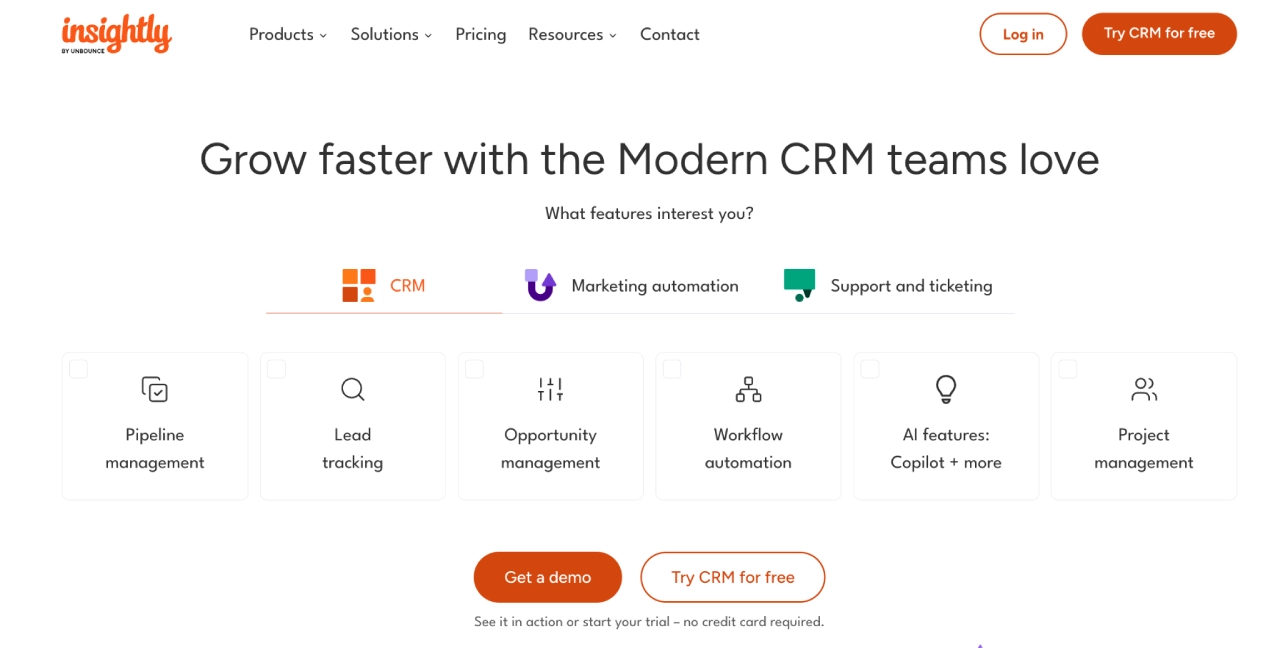
Insightly is a modern CRM that combines sales management with built-in project management, so teams can link opportunities directly to projects and delivery milestones.
Best for: Smaller or mid-sized agencies that want simple CRM + project alignment without deploying separate tools for sales and project delivery.
Key features: Pipelines and opportunity management, workflow automation (Pro & Enterprise), project management, dashboards/reporting, and integrations via AppConnect.
Pricing: 14-day free trial; Tier based pricing per user: $29/mo – Plus; $49/mo – Professional; $99/mo – Enterprise
Pros: Combines CRM + project features on one platform; affordable compared to many enterprise CRMs.
Cons: Full workflow automation is only available on higher tiers; more advanced customization and features require Professional or Enterprise plans
7. Podio — Best for build-your-own CRM setups
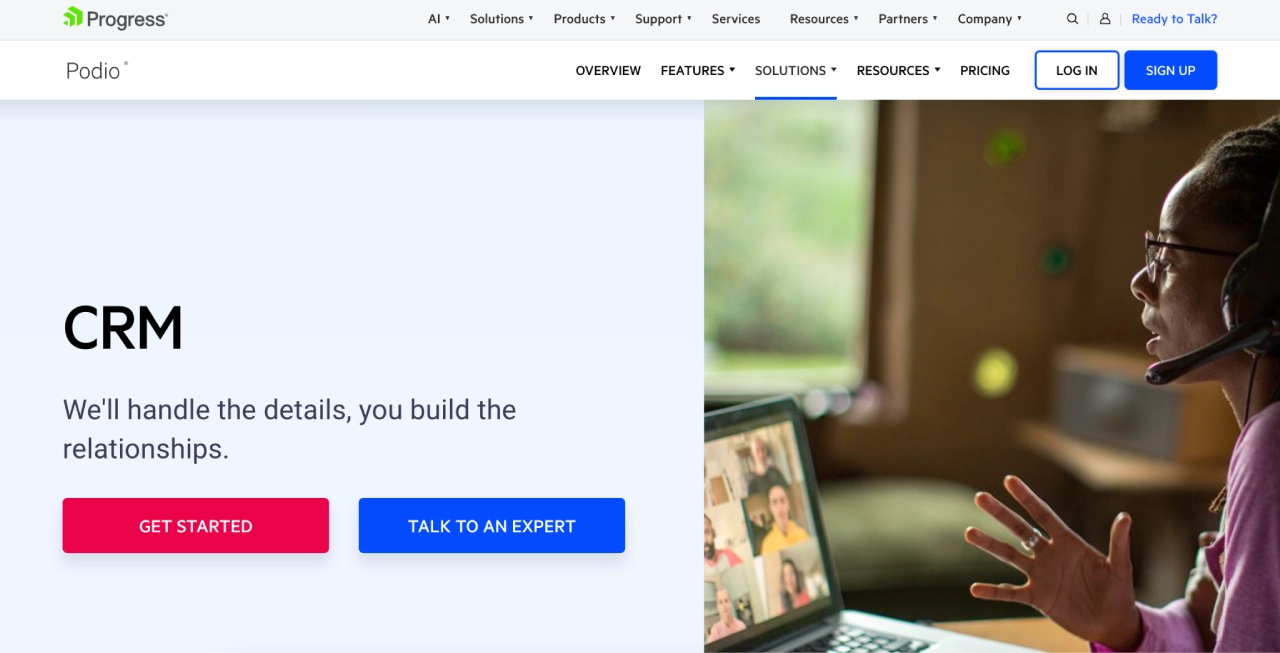
Podio is a no-code work management platform from Progress (formerly Citrix) that lets teams build custom apps and workspaces for CRM, projects, and other workflows. You assemble your own databases, views, and automations, so the system can function as a tailored CRM, project hub, or both.
Best for: Agencies that want maximum flexibility over predefined CRM systems and are comfortable designing their own workflows.
Key features: Custom app builder, multiple views (table/Kanban/calendar), workflow automation, granular permissions, reporting, and integrations.
Pricing: Tier-based per user; FREE (5 employees); $14/mo – Plus; $24/mo – Premium
Pros: Extremely flexible; strong value for teams that will fully use custom apps and automations.
Cons: Requires an “admin/builder” mindset; setup and ongoing maintenance can be heavier than out-of-the-box CRMs.
8. Apptivo — Best modular CRM + operations suite
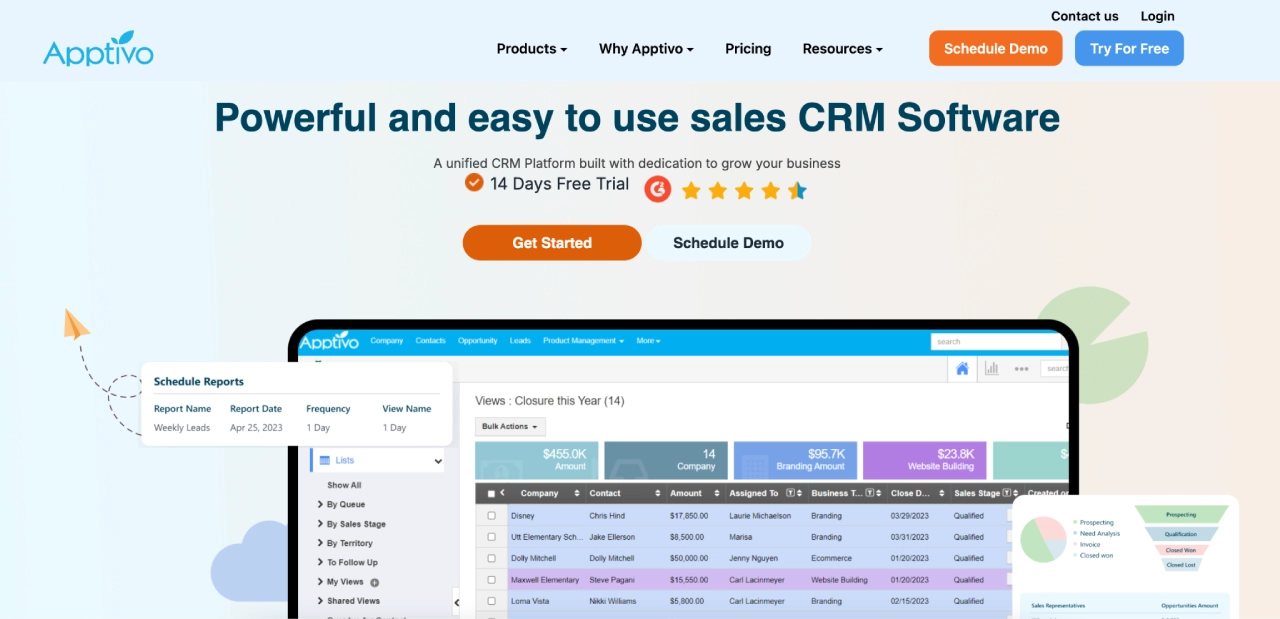
Apptivo is a modular, cloud-based CRM and business app suite that bundles sales, marketing, invoicing, project management, and more into one platform. Teams can turn on 18–65 apps (depending on plan) and configure workflows, fields, and dashboards so the system behaves like a combined CRM + operations hub.
Best for: Agencies that want more than CRM—quotes, projects, invoicing, and basic support—without paying enterprise-CRM prices.
Key features: Workflows, dashboards, reporting, modular apps (sales, projects, invoicing, helpdesk, etc.), and integrations.
Pricing: 14-day free trial; tier-based pricing per user; $20/mo – Lite; $30/mo – Premium; $50/ mo – Ultimate; Contact sales for Enterprise Plan
Pros: Strong automation and breadth of apps for the price; scales from small to larger teams.
Cons: UI is more utilitarian than polished; planning and configuration are needed to get full value from all the apps.
9. Productive.io — Best full “agency OS” with CRM
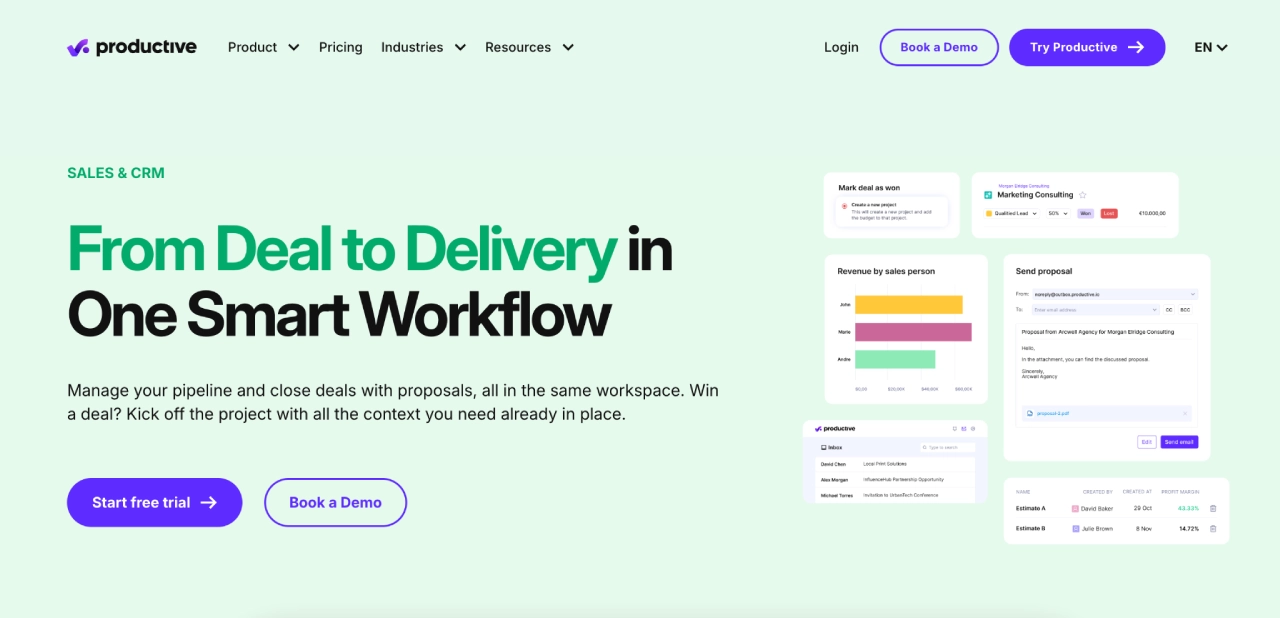
Productive.io is a professional services automation platform built for agencies and consultancies, combining CRM, project management, resourcing, time tracking, budgeting, and invoicing in one tool. It’s designed to run resources, projects, and finances in a single system with real-time profitability insights.
Best for: Digital agencies that want to connect sales with delivery, utilization, and margins instead of stitching together separate CRM, PM, and finance tools.
Key features: Sales CRM and pipeline, budgets, resource planning, time tracking, project/task management, reporting, and invoicing.
Pricing: 14-day free trial; tier-based pricing for 10 users; $11/mo – Essential; $28/mo – Professional; $39/mo – Ultimate
Pros: Connects sales to delivery, budgeting, and profitability; strong reporting and forecasting; purpose-built for agencies.
Cons: Fewer classic CRM/marketing features than tools like HubSpot; best suited when you want an all-in-one agency operations platform rather than a standalone CRM.
10. EngageBay — Best budget all-in-one solution
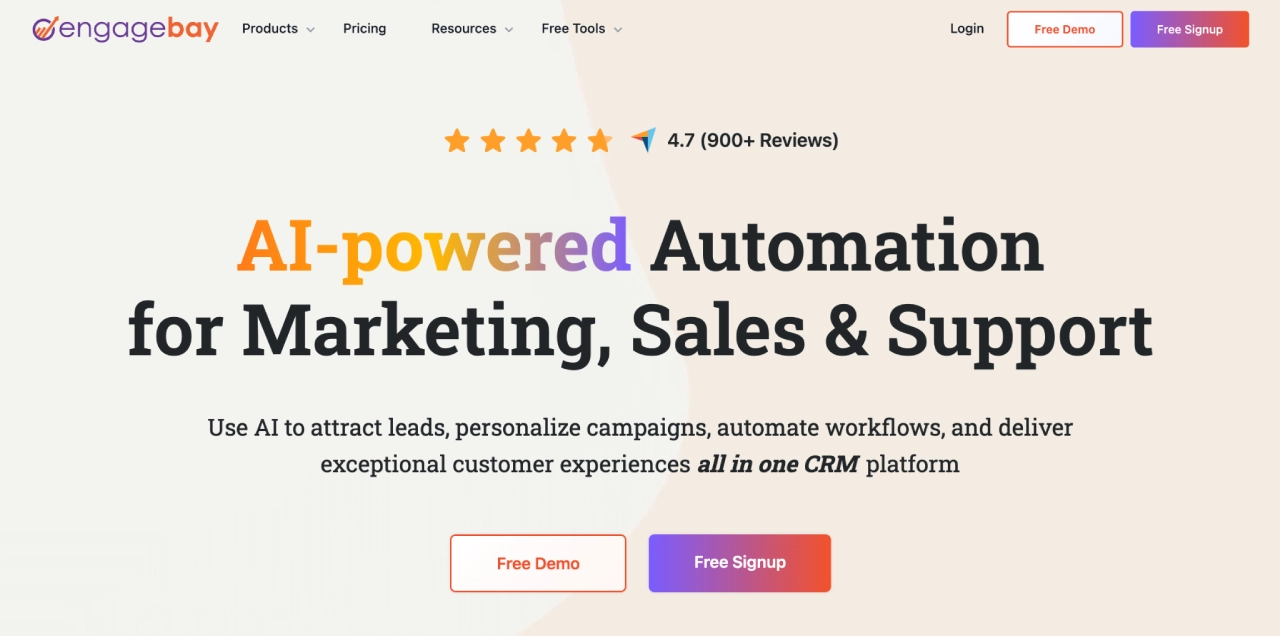
EngageBay is an all-in-one platform that bundles CRM, marketing automation, sales, and helpdesk tools for small and growing businesses. It’s designed to replace multiple point solutions with a single stack for email marketing, automations, live chat, and support.
Best for: Agencies needing an affordable multi-tool bundle (CRM + marketing + support) for small teams and SMB clients.
Key features: CRM & deal pipeline, marketing automation and email campaigns, landing pages, live chat, helpdesk, workflows, and integrations.
Pricing: Tier-based per user; Free/mo; $14.99/mo – Basic; $39.99/mo – Growth; $79.99/mo – Pro
Pros: Strong value for an all-in-one stack; generous free plan (CRM, live chat, helpdesk, email) for up to 250 contacts.
Cons: UI and documentation can feel rough in places; feature caps tied to contact and automation limits; native integrations are less extensive than some competitors.
11. Stackby — Best spreadsheet-database hybrid CRM
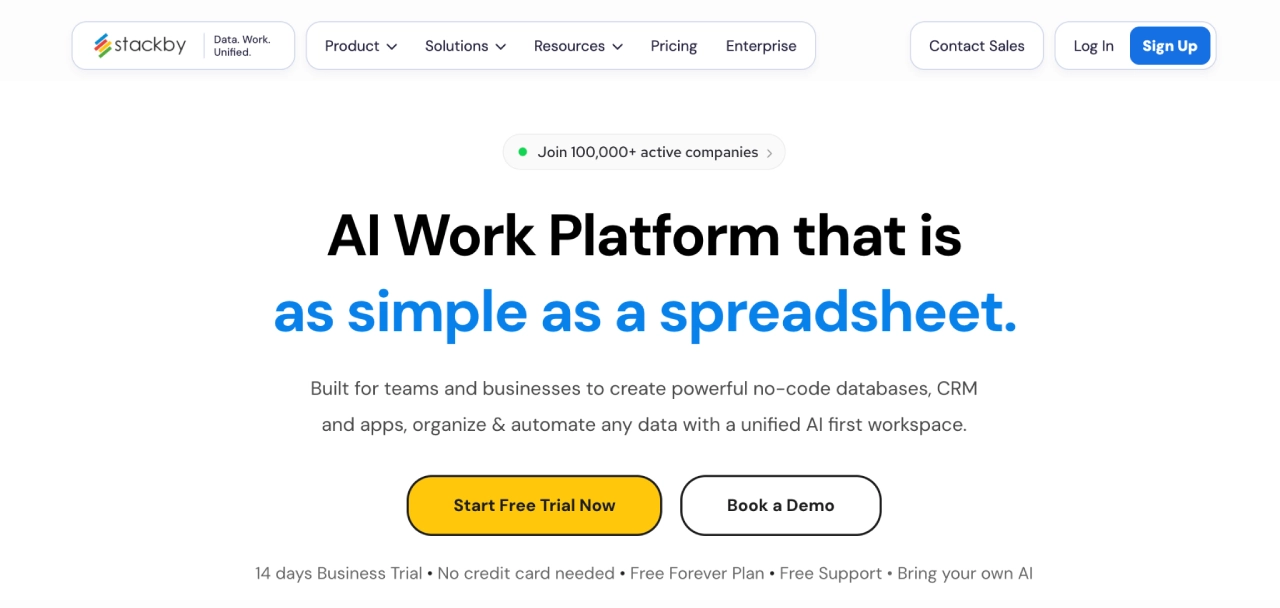
Stackby is a flexible, spreadsheet-style database platform that combines tables with database features and API connections. Teams can build custom CRM-style bases to track leads, deals, and campaigns while pulling data in from other tools.
Best for: Agencies that want full control over structure and views without a heavy, opinionated CRM interface.
Key features: Custom tables and fields, multiple views (grid, Kanban, calendar, forms), API connectors, automations, and user permissions.
Pricing: 14-day free trial per user; Free (5 users); $10/mo – Economy; $18/mo – Business; $30/mo Pro; Contact sales for Enterprise plan.
Pros: Extremely flexible and affordable for building a lightweight, custom CRM or operations hub.
Cons: Not a traditional out-of-the-box CRM; useful setups require planning and configuration.
What agencies should look for in a CRM (Capabilities that actually matter)
Most CRMs look similar on paper—but agencies feel the differences in onboarding, project handoffs, reporting cadence, and how well a tool adapts to service-line complexity.
Use the capabilities below to assess whether a CRM actually reduces operational drag or simply relocates it.
1. Customizable pipelines & flexible views
Agencies need pipelines that mirror real service lines (SEO, paid media, creative, etc.) and adapt per client. Role-specific views, required fields, and standardized stages keep teams aligned and reduce rework.
Why it matters: Faster onboarding, fewer inconsistencies, and a repeatable model you can scale across clients.
2. Real-time dashboards & reporting
Roll-up dashboards for revenue, pipeline health, client KPIs, and forecast snapshots give leaders and AMs instant visibility. Client-facing views support transparency during QBRs.
Why it matters: Clean campaign-to-revenue visibility and less manual reporting.
3. Automation for follow-ups, onboarding & QBR prep
Automate deal creation from forms, renewal reminders, onboarding tasks, SLA check-ins, and pre-QBR workflows. Auto-generate recurring reports so teams aren’t rebuilding them each quarter.
Why it matters: Reduces busywork, prevents delays, and ensures every client gets the same high-standard experience.
4. Collaboration tools (Permissions, notes, notifications)
Role-based access keeps leaders, AMs, and contractors in sync. Standardized tagging (#Risk, #Blocker, #Win) and @mentions ensure nothing slips through the cracks.
Why it matters: Clear ownership and smoother handoffs across distributed teams.
5. Integrations across email, project management & billing
A CRM should connect with your email/marketing platform, support tools, project ops, and accounting systems so contacts, deals, and invoices stay synchronized.
Why it matters: Eliminates double entry, avoids data drift, and reduces tool chaos.
6. Scalability for multi-client management
Workspaces by client, sub-brand, or region help agencies organize growing rosters. Shared templates, naming conventions, and automation libraries make it easy to spin up new accounts without reinventing the wheel.
Why it matters: Supports predictable growth and keeps reporting consistent as the agency expands.
7. Reliable support & migration help
Fast support responses, clear onboarding guidance, and reliable SLAs reduce the operational drag when your team is under deadline pressure.
Why it matters: You can’t afford downtime when client delivery depends on it.
Pro tip: Build a “Gold Standard” pipeline template and clone it per client. Lock core stages but allow client‑specific fields and automations. Your ops team will thank you.
Choosing the right CRM — Agency scenarios
Small creative agency (5–15 people)
Pick: monday sales CRM or Pipedrive
Why: These tools keep things lightweight and visual. Pipelines are easy to understand, onboarding is quick, and the team gets clarity without drowning in config work. Ideal if you want to stay organized without adding friction.
Fast-growing digital agency (15–60 people)
Pick: HubSpot Sales Hub (great native marketing) or Zoho CRM (top customization + value)
Why: As your client list expands, you need stronger automation, forecasting, and analytics. Both CRMs scale well for multi-service teams and let you build more structure without slowing people down.
Multi-client / White-label agency (40+ active clients)
Pick: Salesforce Sales Cloud (complex setups) or Productive.io (full agency OS)
Why: Bigger teams need tight permissions, reusable assets, structured workflows, and a single source of truth across all accounts. Salesforce handles heavy customization; Productive.io connects delivery, budgets, and resourcing into one system.
How Campaign Monitor levels up any CRM setup
No matter which CRM you choose, pairing it with Campaign Monitor gives you cleaner, more reliable client communication.
You get brand-consistent templates, drag-and-drop email design, smart segmentation, and automated journeys that work across every client account.
It makes onboarding, approvals, updates, and reporting easier—without adding another layer of complexity to your CRM.
Mini how-to: CRM + Campaign Monitor playbook
Use your CRM as the source of truth (stages, owners, dates) and Campaign Monitor for journeys, templates, and reporting.
Campaign Monitor supports automated journeys triggered by events, dates, or activity, plus segmentation and reusable templates.
| Motion / Use Case | In the CRM | In Campaign Monitor | Journey / Notes |
|---|---|---|---|
| 1. Welcome & onboarding | Trigger: when a deal is marked “Onboarding”, auto-create tasks (kickoff call, access requests, asset collection). | Build an automated welcome journey for new clients. |
|
| 2. Weekly status rhythm | Auto-create a weekly status task for each active client based on pipeline stage or project status. Use fields (health, risk, last contact) so AMs update one place—not spreadsheets. | Create a reusable status email template (summary, highlights, next steps). Send manually or via a simple recurring journey. Keep replies threaded to one shared inbox or account alias. | Use the CRM as the single source of truth for health/risk, and Campaign Monitor for a clear, consistent client-facing status format. |
| 3. QBR prep | 30 days before QBR, trigger tasks: collect wins, update KPIs, log risks, confirm attendees. Use reports to pull campaign and revenue data by client. | Send a “QBR preview” email with key metrics and a booking link. Include snapshots from Campaign Monitor’s reporting dashboards (engagement, key automations, top campaigns). | The CRM owns dates, tasks, and internal prep; Campaign Monitor sets expectations and gets stakeholders in the room with data-backed previews. |
| 4. Renewal nudge | Flag accounts with upcoming renewal dates or low engagement (few logins, stalled pipeline, low email interaction passed from CM). | Build a short renewal nurture sequence:
|
Use CRM signals (renewal date, usage, risk) to enter clients into the Campaign Monitor journey, then track who renews vs. who needs follow-up. |
Bonus: Turn each flow (onboarding, weekly status, QBR, renewal) into saved CRM workflows + Campaign Monitor journey templates you can clone for any new client.
See how different CRMs connect with Campaign Monitor in practice, explore our CRM-related integrations library in the Campaign Monitor archives.
CRM red flags (CRMs agencies should avoid)
Most CRMs look impressive in demos. The problems show up three months into implementation. Watch for these patterns before you commit:
No real role-based permissions
If you can’t clearly separate internal users from clients—or granularly control what each role can view or edit—you’ll end up with workarounds, data-visibility risks, and limited client access.
Weak or one-way integrations
A CRM that only exports CSVs or relies solely on basic zaps will create manual work. Prioritize platforms with stable, documented integrations to your core tools (email, ecommerce, project management, billing) and, where it matters, two-way sync.
Volume caps misaligned with agency workflows
Contact limits, email send caps, or automation ceilings can look fine on paper but break at scale across many client accounts. These constraints often trigger forced upgrades or rushed migrations.
All-in-one bundles with low adoption
Suites that combine CRM, projects, billing, support, and websites sound efficient—but if your team won’t use most of the modules, implementation complexity rises while ROI drops.
Opaque pricing or mandatory long terms
If costs around seats, add-ons, onboarding, or support tiers aren’t easy to calculate upfront, the true cost of ownership is usually higher than expected.
No clear migration or onboarding path
Agencies require help with data imports, pipeline setup, and training. If a vendor cannot outline a structured migration and onboarding process, the operational burden shifts to your team.
Use these red flags alongside the 4C model: if a CRM scores well on features but fails on integrations, permissions, or pricing clarity, it’s likely to slow you down later.
When you shouldn’t switch CRMs
Even the best CRM won’t fix deeper operational issues. Consider keeping your existing CRM if:
- Your team isn’t using current workflows consistently
- Reporting problems are due to missing data, not system limitations
- You’ve never customized pipelines or automations
- You can solve the pain with better templates, training, or integrations
- The platform supports your needs but isn’t set up optimally
Switching CRMs without addressing workflow fundamentals usually leads to the same problems resurfacing in the next tool.
The 4C agency CRM evaluation model
Most CRMs look similar on a features page—but agencies feel the differences in day-to-day operations. Use the 4C model to score each CRM (1–5 per category). Aim for 16+ if you want a tool that scales.
1. Clarity
How easily can your team (and clients) understand what’s happening?
- Can everyone see status, next steps, owners, and risks at a glance?
- Look for timeline views, roll-up dashboards, and strong audit trails.
2. Collaboration
Does the CRM support smooth teamwork across sales, accounts, and delivery?
- Check for role-based permissions, mentions, threaded notes, and approval workflows.
- Look for clean task handoffs and the ability to centralize client communication.
3. Customization
Can the CRM fit your processes—not the other way around?
- Look for customizable pipelines, fields, forms, reports, and layouts.
- Bonus: Journey builders or automation paths you can adapt per service line or client type.
4. Connectivity
Will it integrate cleanly with the rest of your stack?
- Confirm native connections with your essentials: ads, email, billing, support, and project tools.
- Ideally supports two-way sync where data freshness matters (e.g., email + CRM).
Quick worksheet (Make a copy):
- List your top 3 CRM contenders.
- Score each CRM across the 4Cs (1–5).
- Add your must-integrate tools (e.g., Shopify, WordPress, Salesforce).
- Note which automations you want to reuse across clients (onboarding, QBR reminders, NPS).
- Pick the CRM with the highest score that also supports all must-integrate tools with the least complexity.
To zoom out and understand how CRM fits alongside other touchpoints, this overview of different CRM channels for marketing is a useful companion read.
Final takeaways: Picking the right CRM for a modern agency
The “best” depends on team size, complexity, reporting needs, and integrations with your core stack (ad platforms, billing, helpdesk, email). If you manage many client brands, favor granular permissions and an agency dashboard to keep oversight without bottlenecks.
Choosing the best CRM for agencies comes down to four steps:
- Score each CRM with the 4C model (Clarity, Collaboration, Customization, Connectivity).
- Shortlist the platform that matches your team’s complexity and client volume.
- Standardize onboarding, weekly updates, QBRs, and renewals with templates and automation.
- Pair your CRM with Campaign Monitor for consistent branded communication, automated journeys, and reliable reporting.
When your CRM handles the workflows and Campaign Monitor handles communication, your agency gets clarity, predictability, and a client experience that scales without extra operational overhead.
Try Campaign Monitor free and see how much smoother your client delivery can run.