Introduction
Great email marketing doesn’t happen by accident. It’s built with intention and fueled by strategy. The Ultimate Email Best Practices Guide cuts through the noise to help you focus on what truly drives engagement and results. From deliverability tips to understanding the fundamentals of a winning email design and everything in between, this guide gives you the tools and confidence to create emails that stand out, get opened, and make an impact.

Deliverability
At Campaign Monitor, we don’t just help you send emails — we help you reach the inbox with confidence. Strong deliverability is the foundation of every successful email program, protecting both your reputation and your results. That’s why our team maintains one of the highest delivery rates in the industry — an average of 99%.
Authenticate your domain
Email authentication isn’t just a best practice anymore; it’s a requirement. Beginning in 2024, providers like Gmail and Yahoo began enforcing stricter authentication standards for bulk senders. If you’re sending campaigns to thousands of subscribers, your messages must include SPF, DKIM, and DMARC records that align with your sending domain
These protocols verify that your emails are genuinely from your brand and not from a spammer impersonating you. Without them, your messages may be rejected or automatically filtered to spam, no matter how great your content is..
Learn how to authenticate your domain with detailed steps in Campaign Monitor’s Deliverability and Authentication Video 101.
Keep your opt-ins active and explicit
Even though explicit opt-in to email marketing is mandatory, it's not necessarily evergreen. Even with explicit opt-in, subscriber engagement can fade over time. Stay in regular contact so subscribers remember who you are and why they joined your list. We’ll cover more details on opt-in permissions later in this guide.
Re-engage or remove inactive subscribers
Sending emails to an unengaged list with inactive or dormant addresses can lead to engagement issues such as low open rates, high bounce and unsubscribe rates, and potentially increased spam complaints. Mailbox providers use these metrics to determine your sender reputation and whether your emails will be delivered. We recommend sending re-engagement campaigns to inactive subscribers and removing dormant subscribers who have not been active for 12 months.
It’s important to note that deliverability is everyone’s responsibility and shouldn't be set-and-forget. Campaign Monitor’s Guide to Avoiding Spam Filters and Improving Deliverability outlines the factors that determine whether your email campaigns reach subscribers inboxes, and what you can do to increase your chances of quality email deliverability.
Staying compliant
Compliance is not only a legal requirement but is also the key to driving greater engagement and building strong, lasting relationships with your audience — which is essential for owned channels like email.
Explicitly ask for permission
Before sending any emails, you’re legally required to ask for opt-in permission. Use signup forms that clearly explain what subscribers will receive and how often they’ll hear from you. Remember to always preserve evidence that your audience has opted in to receive emails.
Another opt-in best practice you can implement is a double opt-in (also known as a confirmed opt-in). This additional step involves sending an email after your subscriber completes your sign-up form, asking them to verify their details and confirm their opt-in status.
Campaign Monitor’s signup forms are designed with secure data collection and compliance in mind, allowing you to grow your list with confidence. By using an optimized form, you can nurture leads, increase conversions, and build long-term brand loyalty.
Make unsubscribing easy
Trust is built on choice. Every marketing email should include a simple, visible unsubscribe link so subscribers can opt out at any time. A best practice is to include an easy-to-access unsubscribe link in every email footer. In addition, do not require the user to provide feedback on why they decided to unsubscribe. By making unsubscribing hassle-free, your brand can capitalize on trust and improve brand perception. Follow global email laws
Even if you’re based in one region, your subscribers may live around the world — so compliance should, too. Familiarize yourself with international regulations, like:
These laws share the same core principles: transparency, consent, and respect for personal data. Following them not only keeps you compliant but also reinforces your credibility with subscribers and mailbox providers alike.
Protect your reputation
Compliance goes hand in hand with deliverability. When your emails comply with the relevant regulations and respect subscriber preferences, inbox providers view your domain as trustworthy. A strong sender reputation improves open rates, boosts engagement, and keeps your brand out of the spam folder.
Growing your list
Your email list is the foundation of every great campaign. In a privacy-first world, it’s not about collecting contacts—it’s about cultivating relationships built on honesty and respect. Be upfront about how your business will use subscriber data and why it benefits them. A transparent, permission-based list drives engagement, deliverability, and long-term ROI.
Here are some key steps to consider when growing your email list:
- Capture opt-ins from the outset
When it comes to collecting your customers' email addresses, it’s best to capture opt-ins from the outset. The best way to do this is to leverage your website, social, and digital channels and drive your audience to a signup form. - Offer real value in exchange
Offering a value exchange is a great way to entice your audience to share their data with you. Discounts, early and exclusive access to new products and services, or VIP experiences are all opportunities that subscribers are actively seeking. - Be transparent from the start
The best way to avoid customer annoyance (and potential unsubscribes), is by being transparent about how often you’ll email your subscribers and what type of content they can expect from you. The ultimate goal is to clearly communicate what your customers are signing up for when they share their email addresses, and when you set those expectations, it’s critical to stick with them.
For more ways to refresh and grow your email lists, check out 6 Straightforward Ways to Grow Your Email List.
Establish your email campaign goal

Before you hit send, pause and define what success looks like. Every high-performing campaign starts with a clear goal — one that connects your message to your broader marketing objectives. Whether you’re aiming to drive sales, boost event attendance, or build stronger customer relationships, intentional planning turns good emails into great ones.
The key to setting the right goals for your email campaigns is to align them with your company’s broader marketing goals & KPIs. Is the goal to drive new sign-ups for your product? New leads for your sales team? More attendees for your event? More donations for your cause?
Email marketing is the single most powerful channel for reaching your audience, and it can be used to achieve a number of objectives. Take the time to consider what you want to achieve before diving too deep into your strategy.
Segmenting & personalizing your list
For marketers, understanding and leveraging the unique characteristics of your subscribers is essential to driving engagement. You don’t want to make consumers feel like they’re receiving mass communications. Instead, use what you know about your audience to segment them and send them personalized communications.
Leveraging segmentation is not only key to retaining an engaged list but can also drive a 760% increase in revenue (DMA).
Here are a few ways you can segment your audience to drive maximum engagement:
- Demographic (age, gender, company position)
- Geo-location (country, region, state)
- Subscriber behaviors (previous purchases, contact preferences, engagement)
Designing & writing your emails
Your design and copy are where strategy meets experience. The right combination of layout, visuals, and words can capture attention in seconds and guide readers exactly where you want them to go. Every detail — from your subject line to your call to action — should make it easy for subscribers to engage and convert.
Start with a clear structure
Your layout should lead the eye. Use visual hierarchy to draw attention to what matters most — headlines, images, and calls to action (CTAs). Readers should be able to scan your email and understand your message instantly.
For more information on each of these email design tips, visit our Design Best Practices Guide.
Craft subject lines that get noticed
Your subject line is considered one of the most important factors in getting your emails opened, so make it engaging, personal, and relevant.
Recent studies indicate the best email subject line length is from 30 – 50 characters and up to seven words. Preheaders add valuable context to your subject line and can help drive your open rate. Keep these between 40-70 characters as a best practice. Ensure your subject line and preheader text work together.
Layout
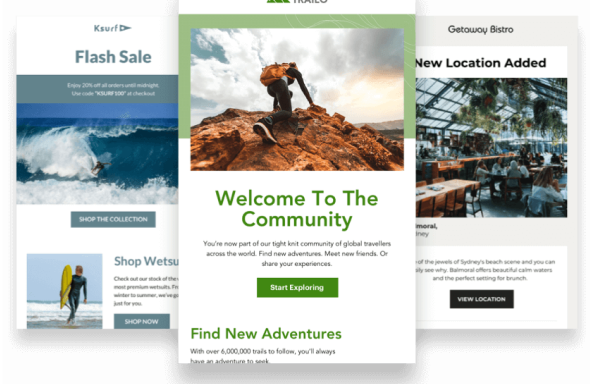
Your email layout should help the viewer know what to check out first and where to go from there. Readers should be able to scan the email quickly using a logical hierarchy with large headlines and images, focusing their attention on specific areas. Use a layout to break up space and help create chunks of content.
Design styles and trends may change, but effective structures like the inverted pyramid and zig-zag still endure!

Imagery
When adding imagery to your email design, make sure you consider the following principles:
- Strike a balance between your imagery and copy. Your most important information should be communicated through copy, rather than relying on images
- Images should complement and connect to your message (not compete)
- Choose images that align with your brand and tone of voice
- Always include alt text and ensure your message still makes sense without images enabled.
By choosing images thoughtfully and aligning them with the message and brand, you can enhance the impact of your emails and maintain a strong and recognizable visual identity.
Copy
When writing email copy, be sure to align with your brand's tone of voice. You should also make sure your message is clear, concise, and not too copy-heavy. Depending on your email’s purpose and its intended audience, nailing the tone of voice is essential. For instance, if you have an important announcement from your CEO, it should have a more formal tone, whereas an end-of-season flash sale may have a more casual approach. Just remember, writing a high-performing email campaign isn’t hard if you stay true to your brand and optimize your central message.
Clear calls-to-action (CTA)
A great CTA blends strong copy, smart design, and strategic placement. Use benefit-driven language (“Get the Guide,” “Start Your Free Trial”) and make sure your button stands out visually with plenty of whitespace.
- Copy: Specific and focuses on the benefit or action
- Design: Stands out, is appropriately sized, and has whitespace around it
- Placement: Ideal placement is relative to the complexity of the offer (you may need more explanation copy before the CTA)
- Amount: Depending on your objective, you may need multiple CTAs in one email. If this is the case, we advise having a primary CTA, which aligns with the main purpose of your email. If additional CTAs are necessary, visually differentiate them by using secondary colors or scaling them down.
Optimize for all devices
Mobile opens have been the majority channel for several years, but the exact percentage varies by industry, audience, and methodology. The typical range across aggregated benchmarks is between 40–60% of email opens come from mobile devices, so responsive design isn’t optional — it’s essential. Campaign Monitor’s platform includes built-in functionality that makes it easy for you to see how your email design renders across different devices before you send.
Ensure accessibility
Email accessibility is the practice of creating emails usable by as many people as possible, especially those with visual or hearing impairments, cognitive or learning disabilities, or mobility issues. From copy to design to code, accessible emails should be easy to understand and engage with.
Designing accessible email campaigns shows your customers — and prospects — that you want everyone to engage with your brand and that you care about the diverse ways people consume digital information today.
Use compliant footers
As mentioned previously, your email must include your company’s address and an unsubscribe link. A best practice is to include these in the footer of all emails. Your legal team may require additional information in your footer, such as terms and conditions (if they apply to your messaging). You can also leverage your email footer to:
- Promote additional marketing channels, i.e., add your social media icons or a link to download an app (if you have one)
- Include a link to your support team or resources
Adopt advanced email design tools
These advanced email design tools can help you take your emails from good to great.
Personalization
Go beyond adding your subscriber’s name in the subject line and use other data you have to fuel relevant messages and inform your email design. Think about adding a company name, highlighting your customer's last purchase, or any other information that helps you to personalize the email design for your subscribers. Stop thinking of emails as one-to-many; think of them as one-to-one.
Dynamic content
Dynamic content supercharges personalization by enabling you to change entire sections of content within your email to make the campaign more relevant and appealing to specific subscribers.
A common use case for this would be showing men’s wear to male subscribers and women’s wear to female subscribers. Campaign Monitor makes it easy for you to leverage dynamic content in your email and contact strategy.
Videos/GIFs/Animations
Any visual elements, such as videos, GIFs, or animations, are an easy way to drive more engagement and interest with your subscribers.
Before you start including videos in all your email campaigns, consider that not all email clients support playing videos directly in the inbox.
For more information on each of these email design best practice tips, visit our Design Best Practices Guide.
Optimal send days and frequencies
Timing is everything. When you send your emails, it can be just as important as what’s inside them. The right cadence helps you stay top-of-mind without overwhelming your audience, while the right send day can give your campaign the lift it deserves. Our 2022 Email Marketing Benchmarks Report analyzed over 100 billion emails sent across Marigold platforms and found that there doesn’t seem to be too much variance in how emails perform on a given day. Generally, weekdays perform best, and engagement is lowest on weekends.
The best way to ascertain optimal send times and frequencies for your business is to A/B Test. A/B testing allows marketers to send small samples of emails to two test groups to determine which performs best. Once your campaign is ready to go, take the time to send a few at different times and dates to see which performs better. It will help you determine what works best for your subscribers.
Testing your emails
Testing is where good email marketing becomes great. It’s how you catch small issues before they hit the inbox and discover what truly resonates with your audience. From quality assurance to A/B and multivariate testing, every test you run helps you send smarter, stronger campaigns.
There are two main types of email testing: quality assurance and variable.
Quality assurance (QA) testing
Before you send any campaign, test every element, including links, images, copy, and layout. A few minutes of QA testing can prevent costly mistakes and protect your brand’s credibility. Here are some elements to check when performing a QA test:
- Links: Verify every link works and directs to the correct page using features such as Campaign Monitor’s Link Review Tool.
- Design: Preview how your email renders across major devices and clients.
- Accessibility: Test alt text, font sizes, and contrast for all readers.
- Spam risk: Run your email through a spam filter test to ensure strong deliverability.
Variable testing
Making assumptions about what content your audience wants can be risky and often leads to subscribers becoming disengaged or even unsubscribing. Variable testing involves sending emails to at least some of your subscribers, with the main purpose of gathering data to help create more effective emails that resonate with your audience.
- Multivariate testing: Marketers use this type of email testing to test multiple variable combinations simultaneously. The goal is to find the best possible set of variables to ensure the success of the email campaign.
- A/B testing: Also called split-testing, works by sending variations of your email to different groups within your email list to see which version performs better with your audience.
Common email elements that can be A/B-tested include subject lines, email copy length, images, CTA colors or shapes, and send times.
6 best practices to make your A/B testing strategy smarter and more effective.
- Have an end goal: Identify your end goal or objective.
- Conduct simultaneous tests: Run both split-tests at the same time.
- Keep a control version: A/B testing works best if one of the variations is your original email campaign. This is your reliable baseline.
- Act on statistically significant results: Perform email testing on the largest subset of your email list as you can. This will increase the accuracy of your results.
- Test continuously and test often: You should always run multiple A/B tests with new goals to continually optimize your results.
- Trust the data: Don’t ignore the results when they come in. Don’t wait until your email list evolves and your subscriber behavior and demographics change completely before getting around to your action plan.
Reviewing & optimizing campaigns
Consistently reviewing your campaign performance is key to achieving your marketing objectives.
Here are the most fundamental metrics you should be tracking after each campaign:
Open rate
The percentage of delivered emails that were opened.
Formula: (emails opened ÷ emails delivered) × 100
With Apple’s Mail Privacy Protection (MPP) impacting open tracking, consider open rate as a directional metric rather than an absolute one.
Learn more in Campaign Monitor’s Ultimate Email Marketing Benchmarks Guide
Click-through rate (CTR)
The share of subscribers who clicked a link, image, or CTA. CTR is one of the best indicators of how compelling your content and CTAs are.
Formula: (unique clicks ÷ emails delivered) × 100
Unsubscribe rate
The percentage of subscribers opting out after a send.
Formula: (unsubscribes ÷ emails delivered) × 100
A rate above 0.5% could indicate frequency fatigue or content misalignment.
Click-to-open rate (CTOR)
The click-to-open rate or CTOR is a measurement of how many click-throughs are received through opened emails. Essentially, it measures how engaging your content is after the open.
Formula: (unique clicks ÷ unique opens) × 100
Campaign Monitor found that the average CTOR should fall between 6-17%, depending on the industry you’re in.
Bounce rate
The percentage of undelivered emails (hard or soft).
Formula: (bounced emails ÷ total sent) × 100
Keeping your list clean through regular hygiene practices helps maintain strong deliverability.
Spam rate
The number of recipients marking your email as spam.
Formula: (spam complaints ÷ emails delivered) × 100
Ideally, this stays under 0.1%. High complaint rates signal a need to review list quality or frequency.
Email as part of your multi-channel strategy
Email doesn’t exist in isolation—it’s the cornerstone of a connected marketing strategy. When paired with other owned and paid channels, it helps you reach customers wherever they are and keeps your brand top of mind long after the first click. With this in mind, your email marketing strategy should be integrated with your other marketing efforts, such as SMS, paid digital, and your website.
As you work to make email a strong part of your marketing strategy, keep your overall goals in mind, continually monitor KPIs and objectives, and continue segmenting and personalizing your lists to maximize ROI and make your strategy worthwhile.
Drive results with email marketing
By applying these best practices, your email marketing becomes more than a communication tool — it becomes the engine behind your customer relationships, your brand story, and your growth.


Connect your favorite tools to Campaign Monitor
Seamlessly connect your ecommerce platform, CRM, website and more.
Browse integrations
Case Study
This nonprofit uses advanced tools and automation to create more emails—and more time.
Learn how
The email platform for agencies
We started out helping agencies with email, so let us help you.