8 minute read time
The cost of overthinking every email

Overthinking email marketing delays results, and every hour spent debating subject lines or perfecting button placement is an hour your competitors spend reaching subscribers. Does your organization have campaigns stuck in review and waiting to be launched? That’s revenue sitting on the table.
In this blog post we’ll discuss the cost of overthinking, how to distinguish decisions that deserve deep thought from those that don’t, plus an emergency protocol for when you’re stuck in a spiral.
The hidden math of what overthinking actually costs
Most marketers know that overthinking wastes time, however few have calculated the true cost of these delays. When you quantify the financial impact of decision fatigue, it becomes clear that teams can’t afford to waste time overthinking instead of sending emails and launching campaigns.
Calculate your overthinking cost
To calculate the true dollar amount behind your overthinking cost, use this formula:
- Hourly salary rate × hours spent overthinking per campaign × number of campaigns = total overthinking cost.
Start by tracking these costs each month or week, then project them across 12 months to get your annual overthinking amount. This total will reveal how decision paralysis and perfectionism in marketing have a tangible impact on your budget, and costs your team unnecessary time. Even seemingly minor decisions can cause time and efficiency losses that your team can easily avoid if equipped with the right tools and mindset.
The compound cost of small decisions
Low-stakes decisions attract disproportionate attention precisely because they feel low-risk.
Button color debates can consume more time than email sequence strategy discussions. There’s no catastrophic downside to getting it wrong, so the conversation stretches to fill available time. When you send campaigns regularly throughout the year, those extended debates add up to significant lost time focused on elements most subscribers might not consciously notice. It can be even worse if those debates lead to delays in sending, or in a lack of email sending altogether because a decision can’t be reached.
What you sacrifice while overthinking
Emails that don’t get sent generate zero return on investment, regardless of how perfect they were written or how well they were designed. Email marketing delivers $36 to $42 for every dollar spent, making it one of the highest-return marketing channels available. Every week of delay is a lost revenue opportunity as competitors occupy subscribers’ inboxes while your team debates perfect pixel alignment.
The team morale cost runs deeper than quantifiable numbers on a spreadsheet, and might not be noticed until someone burns out. Perfectionism breeds bottlenecks by signaling that nothing is ever good enough, which demotivates high performers and creates email campaign paralysis that spreads to every marketing initiative.
Not all decisions deserve the same amount of thought
Without a clear framework for marketing decision-making, teams treat every choice as equally important. This framework, or lack thereof, causes the team to waste time on low-impact variables and rush the execution and planning of high-impact strategy.
High stakes vs. low stakes decisions
Some decisions have long-term impact and limited reversibility. A good example of this being new audience segmentation, which affects every campaign you send to that audience moving forward. If you get the logic wrong while segmenting your list, it means your team is repeatedly sending irrelevant messaging to uninterested audiences, teaching them to tune out your communications. Brand messaging pivots influence how your market and audience perceive you, and credibility is hard to rebuild once lost.
On the other hand, major automation workflow changes and compliance requirements carry risk because they affect multiple customer touchpoints or regulatory standards. These decisions deserve days or weeks of research and testing because a single mistake can compound across your entire email program.
Other decisions are testable, reversible and carry minimal downside. Test two or three subject line options, pick one and move on. Picking a send time within reasonable windows matters less than a consistent and relevant presence in your customer’s inbox.
CTA button color, wording tweaks, image selection from on-brand options and email order within a sequence are all elements you can change in the next campaign. You and your team will learn more from sending and measuring the results than from debating hypotheticals.
The good enough to ship checklist
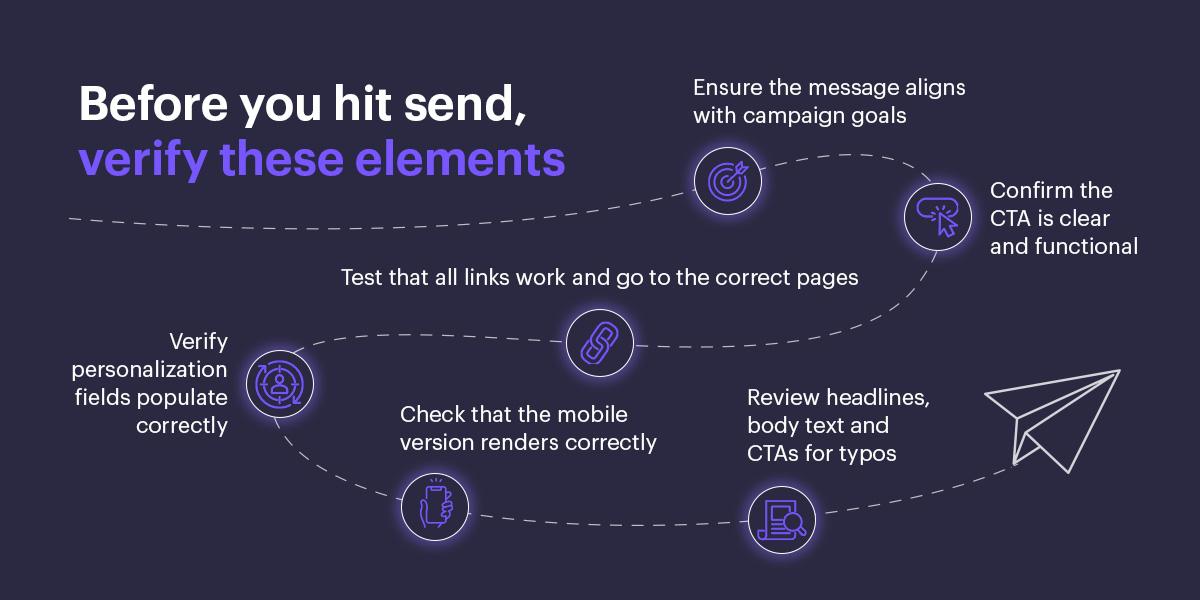
Before you hit send, verify these non-negotiable elements:
- Ensure the message aligns with campaign goals
- Confirm the CTA is clear and functional
- Test that all links work and go to the correct pages
- Verify personalization fields populate correctly
- Check that the mobile version renders correctly
- Review headlines, body text and CTAs for typos
Image alignment to the pixel, exact subject line phrasing, send time precision and secondary copy tweaks don’t need to be perfect. Focus your energy on strategy and segmentation while shipping fast on execution details and testable variables.
Why smart marketers ship good enough emails
Marketers know perfectionism is counterproductive, yet many still practice it. The data you gather from your campaigns gives you permission to decide elements and send emails faster, because the data shows that perfection doesn’t correlate with performance, relevance does.
Here’s why smart marketers ship good enough emails:
- Perfection doesn’t improve performance: The average open rate for an email marketing campaign is 36.5%. Subscribers scan emails in seconds and don’t notice a pixel-perfect detail. A/B testing beats guessing every time, so test two subject lines, pick the winner based on data and move to the next campaign. Segmentation drives results, with targeted campaigns generating up to 760% more revenue than batch-and-blast approaches.
- Speed is a competitive advantage: Subscribers receive dozens of emails daily, so inbox presence matters more than polish. Timely campaigns around events, seasonal offers and trending topics lose value when delayed. Testing velocity matters too, as teams that ship twice weekly learn faster than teams that perfect one email monthly. This approach helps you overcome email marketing productivity challenges by prioritizing learning over perfection.
- Your team is watching: Shipping builds confidence, and teams that launch regularly gain momentum and skill. Give your team permission to ship good work instead of demanding perfect work and watch testing velocity increase.
Emergency protocol: You’re overthinking right now
Knowing that overthinking is counterproductive doesn’t help when you’re stuck in it. You need an immediate escape plan you can deploy today, so here’s what you can do to get your email campaign moving again:
- Question: Ask what the worst realistic outcome is if this isn’t perfect. Usually, the answer is that the subscriber doesn’t notice or the open rate changes slightly.
- Evaluate: Identify what’s testable versus what requires a one-time decision. Testable elements should be shipped and measured.
- Decide: Set a decision deadline by setting a 15-minute timer. A constraint will force you to act.
- Execute: Apply the good enough to ship checklist. If your email ticks all the boxes, ship it. If you’re still stuck after this protocol, you might need a clearer strategy or more decision-making authority.
Once you’ve done this, establish review cycles. Monthly audits help you assess what you obsessed over versus what actually moved metrics.
You could decide that:
- Email copy gets reviewed twice before it ships
- Campaign managers own subject lines
- Directors own messaging pivots
What to do instead of overthinking
A testing culture beats a perfection culture every time, which is why your teams should ship A/B tests rather than debating which option is best. When you review campaign performance, focus on the elements that moved open rates, clicks and conversions. Celebrate shipping velocity by recognizing teams that tested three subject line approaches this month.
Your email marketing platform should handle decisions you don’t need to be making manually. For example, a platform that provides you with email templates reduces the number of design decisions you face, while automation handles send time optimization and triggered campaigns. These platforms should exist to remove friction from your workflow so your team can focus time and energy on strategy.
Why trust Campaign Monitor?
We founded Campaign Monitor in 2004 on a simple principle of helping marketers create and send beautiful email campaigns without unnecessary complexity.
Our drag-and-drop email builder requires no coding and lets you craft emails in minutes, while our prebuilt templates reduce design decisions by automatically applying your brand. AI Segment Mapper turns plain-language descriptions into precise audience segments with just a few clicks; instead of manually building segmentation logic, describe who you want to reach and the platform handles the technical work. Automated email journeys let you review and refine campaign types to meet subscribers at key moments of their journey.
Our platform’s analytics capabilities show you what’s working, so you replace debate with data. With intuitive tools and streamlined workflows, you spend more time connecting with subscribers and less time deliberating over details that don’t move metrics.
Stop overthinking every email with Campaign Monitor
The cost of overthinking is measurable and avoidable. Campaign Monitor gives you the tools to ship confidently and grow faster. Our platform lets you easily create and send beautiful campaigns.
Sign up for a 14-day trial today.