8 minute read time
How to plan email campaigns when marketing is only part of your job

You’re a business owner, an operations manager, a sales lead, and also the marketing person. Planning email campaigns keeps sliding down your to-do list because there’s always a customer issue to resolve, inventory to manage, and a sales call that can’t wait. Email marketing is important, but it never seems urgent enough to survive amidst the daily chaos of running a business.
You don’t need to become a full-time marketer to see real results from email, you need a system that fits into the time you have. A repeatable campaign framework that takes just a few focused hours each month can keep your business top-of-mind with customers and drive consistent revenue.
Why email marketing gets dropped, and why you can’t afford to
Email marketing often falls by the wayside for small businesses because it competes with tasks that feel more immediate.
Customer issues and sales calls have clear deadlines and visible consequences, while marketing goals feel abstract and long-term. This forces you to prioritize what’s loudest, not what’s most important for future growth. Around 56% of small business owners have an hour or less to spend on marketing each day, which means email marketing keeps getting pushed until months pass with little to no customer communication.
When you stop sending emails, your list goes cold, subscribers forget who you are, and future emails are more likely to be ignored or marked as spam. Meanwhile, your competitors stay top of mind, building trust while you’re silent. Email marketing can generate an average return of $36 to $42 for every dollar spent, meaning every month you don’t send, you’re leaving potential revenue on the table.
A straightforward email sent regularly outperforms a flawless one that sits in your drafts or doesn’t get sent at all. You can let automation handle repetitive touchpoints like welcome emails to build relationships on your behalf so you can focus on crafting more personalized messaging.
The time-block email planning framework
A time-blocking method consolidates your efforts and protects your focus from being pulled away by the louder tasks you need to deal with. Here are three techniques to help create a full quarter of campaigns, turning email marketing calendar planning into a predictable routine.
1. Quarterly planning session (90 minutes, once per quarter)
At the start of each quarter, set aside 90 minutes to map out your strategy. Begin by reviewing a calendar for the next three months and listing industry events and internal milestones. From there, decide on high-level themes for your emails and list three to five existing assets you can reuse to support those themes, like blog posts, guides, case studies, or popular social posts. Before wrapping up, check that your welcome series runs correctly and that links still work.
2. Monthly batch production (2 hours, once a month)
Rather than scrambling to create individual emails throughout the month, dedicate a single two-hour session to building everything at once. This batching technique keeps you in a focused state instead of constantly switching between marketing and operational tasks.
Open your quarterly plan and identify the themes for the month ahead. Write the copy for four to eight emails using your content inventory, then load everything into templates and schedule the sends. When you finish this session, you’ll have handled your entire month of email marketing.
3. Weekly monitoring every Friday
Brief weekly check-ins help you stay responsive. Every Friday, look at open rate, click-through rate, and unsubscribe rate for big-picture trends rather than minor fluctuations. If you notice a pattern, adjust your approach for the next send. Also, check reports for deliverability issues or bounces that might signal technical problems.
Here’s the total time investment per quarter:
- Quarterly Planning: 90 minutes (1 session)
- Monthly Batching: 6 hours (3 sessions at 2 hours each)
- Weekly Monitoring: 3 hours (12 sessions at 15 minutes each)
- Total: Approximately 10.5 hours per quarter, less than one hour per week
What to automate, and what needs your attention
Email marketing automation maintains consistent communication, freeing you to focus on the strategic messages that require your unique voice and current perspective.
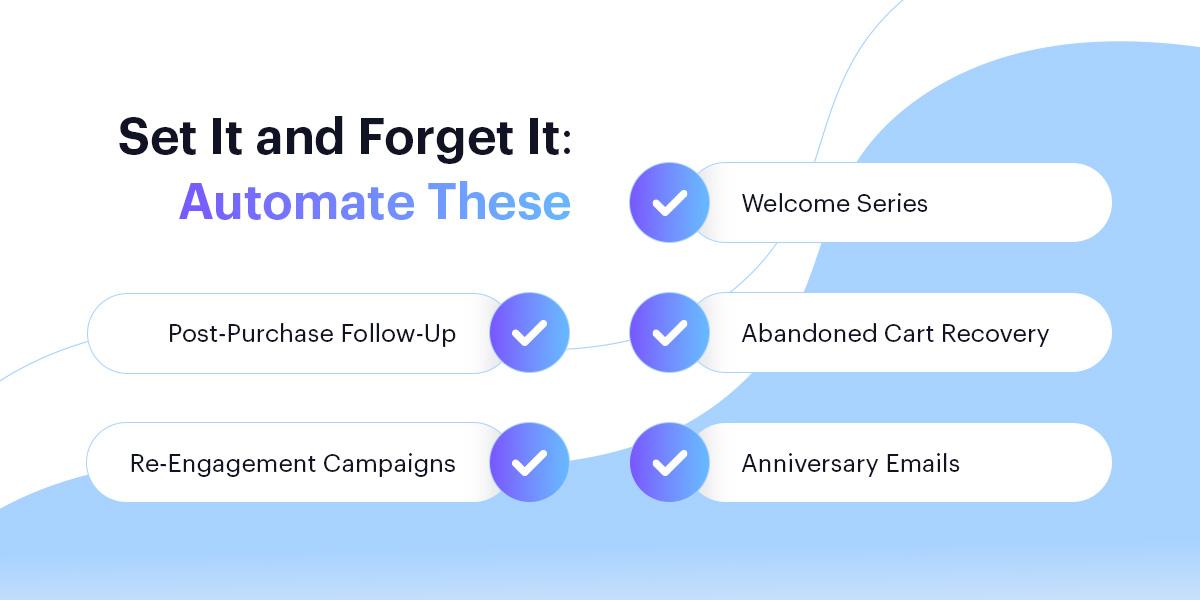
Set it and forget it: Automate these
These campaigns run based on subscriber behavior or dates, making them perfect candidates for automation:
- Welcome series: An automated welcome series of three to five emails after a user signs up introduces your business, sets expectations, and delivers immediate value while your subscriber’s attention is at its highest.
- Post-purchase follow-up: Sending automated sequences to thank customers at the right moment and request reviews when the experience is fresh can build loyalty and lead to repeat business.
- Abandoned cart recovery: Automated recovery emails recapture revenue that would otherwise be lost, working around the clock without your involvement.
- Re-engagement campaigns: Automating re-engagement sequences helps detect inactive contacts and attempt to win them back, or maintain a healthy list by removing those who no longer engage.
- Birthday and anniversary emails: These personal touches build goodwill and keep your brand memorable, triggering automatically based on subscriber data you’ve collected.
Keep these manual: Your quarterly broadcasts
These campaigns require your current voice and judgment because they establish your expertise and typically don’t lend themselves to automation:
- Newsletters and updates: Current events, recent achievements and timely news require fresh writing, making these perfect for your monthly batching sessions.
- Product launches: New product announcements require careful coordination across your business and strategic messaging that aligns with launch timing and positioning.
- Seasonal campaigns: Holiday promotions and time-sensitive offers require crafting in response to current market conditions and business priorities.
- Thought leadership: Your perspective on industry trends and professional insights must be current and authentic.
Smart shortcuts for time-strapped marketers
When time is scarce, these time-saving email tips help you maintain consistency:
- Use what you already have: Rather than starting from scratch, repurpose what already exists. A popular blog post can become a three-part email series covering its main points. Customer case studies translate naturally into testimonial emails, while your FAQ page provides ready-made topics for tip-of-the-week content.
- Embrace templates: Create two or three core templates with your logo, colors and fonts preloaded to ensure brand consistency.
- Let AI help: Use AI-powered features to brainstorm subject line options for your summer sale or draft an introductory paragraph for a new product announcement. Treat it as a starting point, and always review and edit what it generates to ensure the tone matches your brand and that the information is accurate.
How Campaign Monitor helps part-time marketers
The right platform can make the difference between abandoning email marketing and turning it into a reliable growth channel. We designed Campaign Monitor to remove technical barriers so you can focus on strategy and messaging. Some capabilities include:
- Drag-and-drop email builder lets you assemble professional emails in minutes. Input your website URL, and the platform automatically imports your brand colors and logo.
- The template library and resources provide mobile-friendly starting points that adapt to any device, so you spend time crafting your message instead of troubleshooting display issues.
- Automation workflows and journeys use a visual journey designer that makes complex automation approachable. Build welcome series, abandoned cart sequences, and re-engagement campaigns that run continuously without manual intervention.
- The calendar view consolidates all scheduled campaigns in one place, giving you a clear picture of your consistency at a glance.
- AI-powered subject lines help you overcome writer’s block by generating compelling options directly in the editor.
- Mobile-optimized by default, so you feel confident that your emails will look great on any device. Every template is automatically responsive, saving you from complex testing and coding.
Why trust us?
Campaign Monitor focuses on making sophisticated email marketing accessible to everyone. We serve businesses globally, with robust capabilities for marketing experts and intuitive interfaces for those juggling multiple responsibilities. Our platform handles complexity behind the scenes with features like our automatic brand import, email segmentation, and a large template library, so you can focus on connecting with your customers and driving revenue growth.
Our support team maintains a 90-minute average response time and provides coverage across time zones. We also offer extensive guides, webinars, and professional services to help you get more from your email marketing investment. With hundreds of pre-built integrations to e-commerce platforms and website tools, Campaign Monitor fits into your existing workflow.
Block your first 90 Minutes and get started
A consistent plan, executed regularly, will outperform a perfect strategy that never launches. The framework is clear, and the time commitment is manageable. What’s left is blocking off that first 90-minute planning session and building your quarterly email calendar.
Sign up for free today to see how Campaign Monitor can support your business.